We Have Wellness At Home
Wellness has become a booming industry, and booming industries have a sneaky way of wandering away from the very things that gave them meaning in the first place.
Search #wellness on social media and you will probably encounter color coordinated yoga outfits, immaculate morning routines, expensive retreats, aesthetic water bottles, supplements, saunas, spas, and people who appear to have somehow eliminated to-do lists, deadlines, and dirty dishes from their daily lives. Before long, wellness can start to feel like just another thing we are expected to purchase and perfect before we are allowed to enjoy any of its benefits.
Some of those things can be lovely, after all beauty and ritual have always belonged to us. There is nothing wrong with a beautiful yoga mat, a boujee candle, or a fancy spa day that helps you feel grounded. But fancy is optional, especially when it comes with a price tag, and wellness should never become another standard we have to meet before we are permitted to feel good in our own bodies and lives.
So before the back-to-school rush gives way to the back-to-back holidays and all their built-in busyness, we’d like to invite you to think about wellness a little differently. Not as something you have to earn, but as something you can practice right where you are. Not as an elaborate reinvention of your life, but as a series of small ways to reconnect with yourself, your community, and the natural world around you.
We’ll start with the simplest possibilities and move gradually toward bigger ones, because caring for ourselves can begin with five minutes outside just as surely as it can begin on a hike.
But first, let’s go back to the beginning.
A natural history
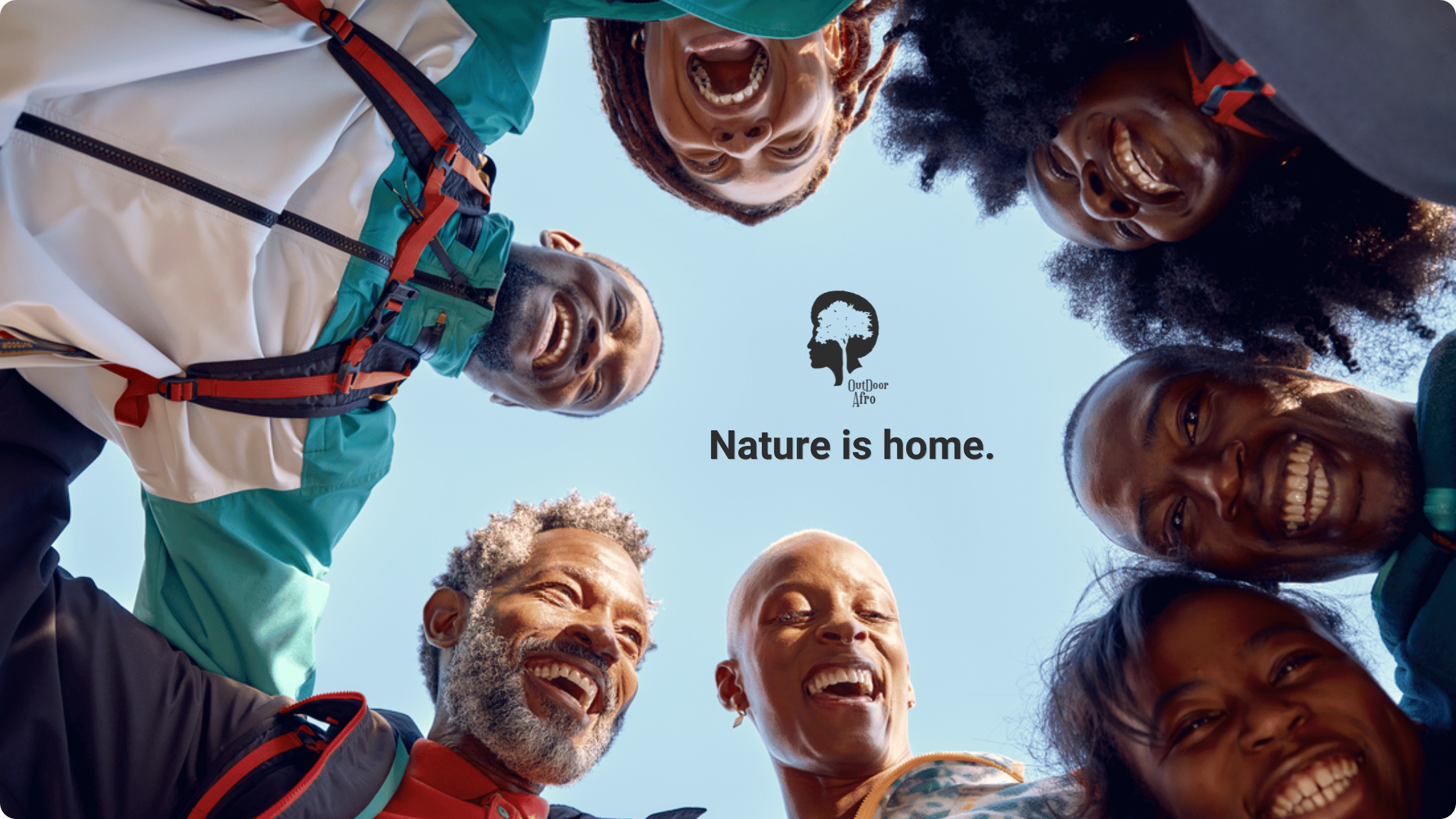
Outdoor Afro was founded 17 years ago to celebrate and inspire Black connections to and in nature, and that mission begins with a truth many of us already know somewhere deep in the body: nature is not a luxury waiting for us at the end of achievement. Nature is home.
It’s the park and the creek, the trail, the lake, the trees and the birds moving across the morning sky with absolutely no concern for whatever is happening in the news.
Nature is present not only around us, but in the memories that shaped us. It’s greens being washed in the sink, the auntie whose houseplants are lined up like favorite cousins, the family reunion beneath a great tree, the uncle who knows where the fish bite, and the little kids running toward an open patch of grass because their bodies seem to understand the need for nature before ever thinking too deeply about it.
For many of us, connection with nature is already woven into the ordinary textures of life, even if we have never described those experiences as “outdoor recreation.” Maybe nobody in the family owned technical hiking boots, but there were afternoons in the yard, cookouts in the park, fishing trips, walks after dinner, stoop conversations under a summer sky, or long drives toward somebody’s favorite piece of land. Nature has always had a way of appearing around the edges of our lives, reminding us that the outdoors is not somewhere we have to travel to become worthy of entering.
But modern wellness can sometimes make us feel as though we need to become someone else before we begin. Outdoor Afro offers another possibility: reconnecting with something that has already been ours, even when we are experiencing it in a completely new way.
Maybe that looks like joining an Outdoor Afro outing and climbing into a kayak for the first time, learning how to hold a paddle and discovering the delicate balance between your body, the boat, and the water. Or maybe it’s casting a fishing line for the first time and learning that patience really is a virtue, while also discovering that sitting quietly beside a creek can be its own kind of rest. Or maybe you give birding a chance and realize that simply paying attention can transform an ordinary patch of sky into a neighborhood full of extraordinary feathered friends.
At the beginning, you might not know the names of the gear, the rules of the activity, or the rhythm of the group yet. None of that disqualifies you. Expertise can come later. Confidence can come later. Belonging does not have to.
You are already home.
Start with five minutes outside
Wellness can begin with something almost absurdly simple: open the door.
Alright, you’re all inspired now and ready to delve into wellness, well where to begin? Step outside and give yourself a moment before deciding what you are supposed to do next. Feel the temperature on your skin. Look up at the sky. Find something green. Notice where the light lands. Listen first for the loudest sound around you, then for the quietest one. There is no performance required and no particular insight you have to achieve. The simple act of noticing can be enough.
If it feels comfortable and safe, take off your shoes for a few minutes and let your feet meet grass, sand, soil, or another natural surface. Research into “grounding,” or direct physical contact with the earth, is still emerging, with small studies exploring possible positive effects on mood and physical wellbeing. [1] That means it is best approached with curiosity rather than big promises. You do not need to believe that standing barefoot in the grass will cure anything in order to appreciate the simple pleasure of cool ground beneath your feet, the slight unevenness of soil, or the feeling of sand shifting underneath your weight.
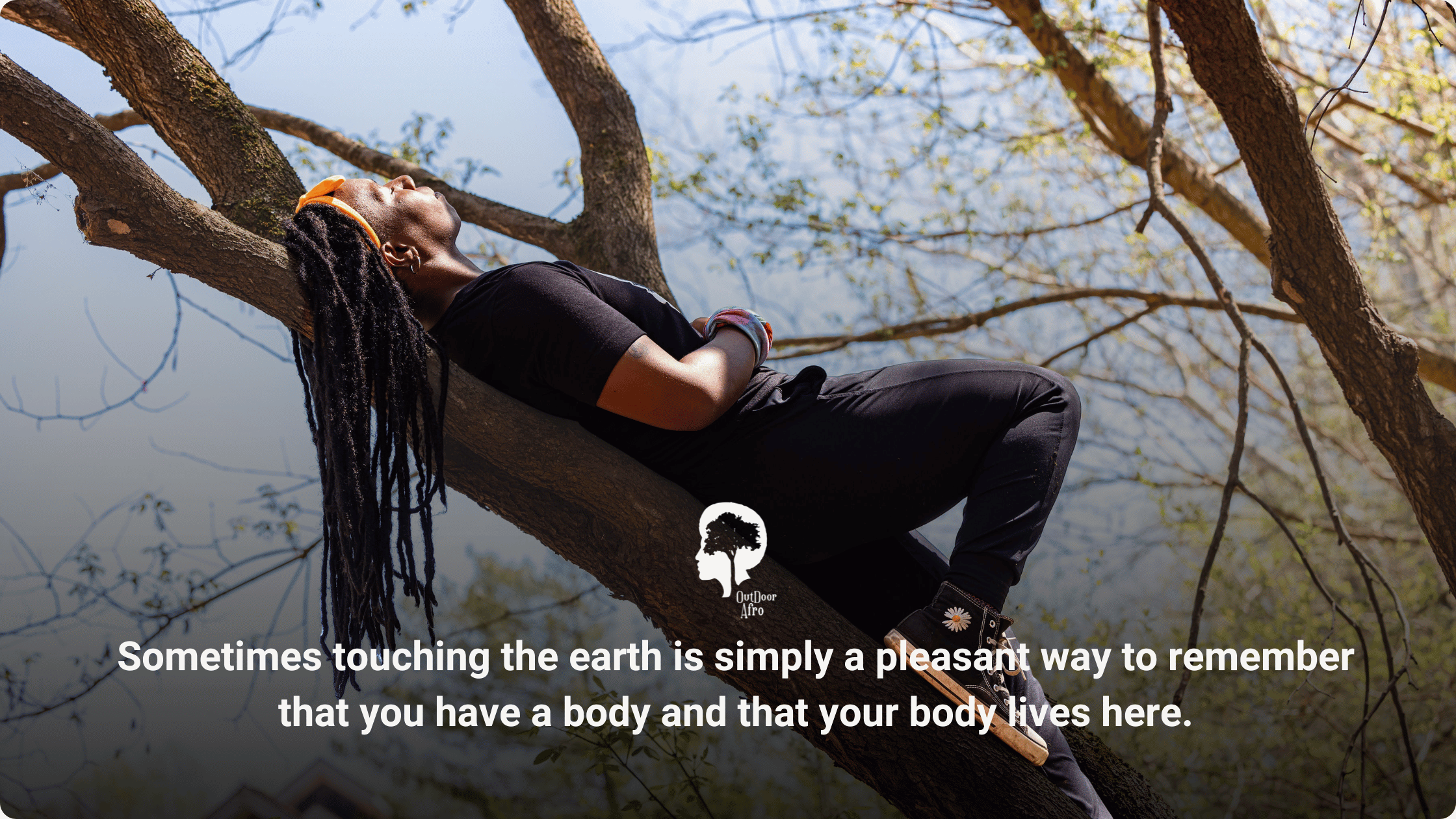
Sometimes touching the earth is simply a pleasant way to remember that you have a body and that your body lives here.
From there, let your attention move toward your breath. Take one breath that reaches a little deeper than the ones you were taking indoors. Let the exhale stretch gently longer than the inhale and notice whether your shoulders soften on their own. Breathing practices have been studied for their effects on stress, blood pressure, heart rate, and other biomarkers of a happy nervous system. [2] Outside, breathing can feel less like another wellness assignment and more like part of the landscape itself, with air moving through leaves, into your lungs, and back into the world.
You are not optimizing anything. You are simply outside, breathing air, noticing where you are, and allowing that to be enough for a few minutes.
Stay long enough to notice something
If five minutes feels good, let the moment widen.
Stand beneath a tree, wander slowly through a park, sit beside water, or try a little forest bathing by moving without rushing and letting your senses lead. Forest bathing does not require any particular equipment or level of expertise. At its simplest, it is an invitation to spend time among trees and pay deliberate attention to what you can see, hear, smell, and feel.
Notice the temperature and the pattern of light on the sidewalk. Pay attention to the smell of grass after rain or the texture of bark beneath your hand. Listen to the way leaves move when the wind passes through them. Watch insects doing their tiny, serious work. Notice how much life is carrying on around you without asking you to solve, improve, or accomplish anything.
Research into nature exposure and practices such as forest bathing has associated time in green spaces with benefits related to stress, blood pressure, sleep, physical activity, and mental wellbeing. [3] [4] But the appeal does not have to live entirely in the research. There is also something wonderfully uncomplicated about spending time in a place where your only responsibility for a few minutes is to notice what is already happening.
Maybe you went outside feeling wound up and came back a little calmer. Maybe nothing dramatic happened at all, but you noticed a bird you had never seen before. Maybe your mind wandered in ten directions and then, for one small moment, landed on the sound of rain against leaves.
That counts.
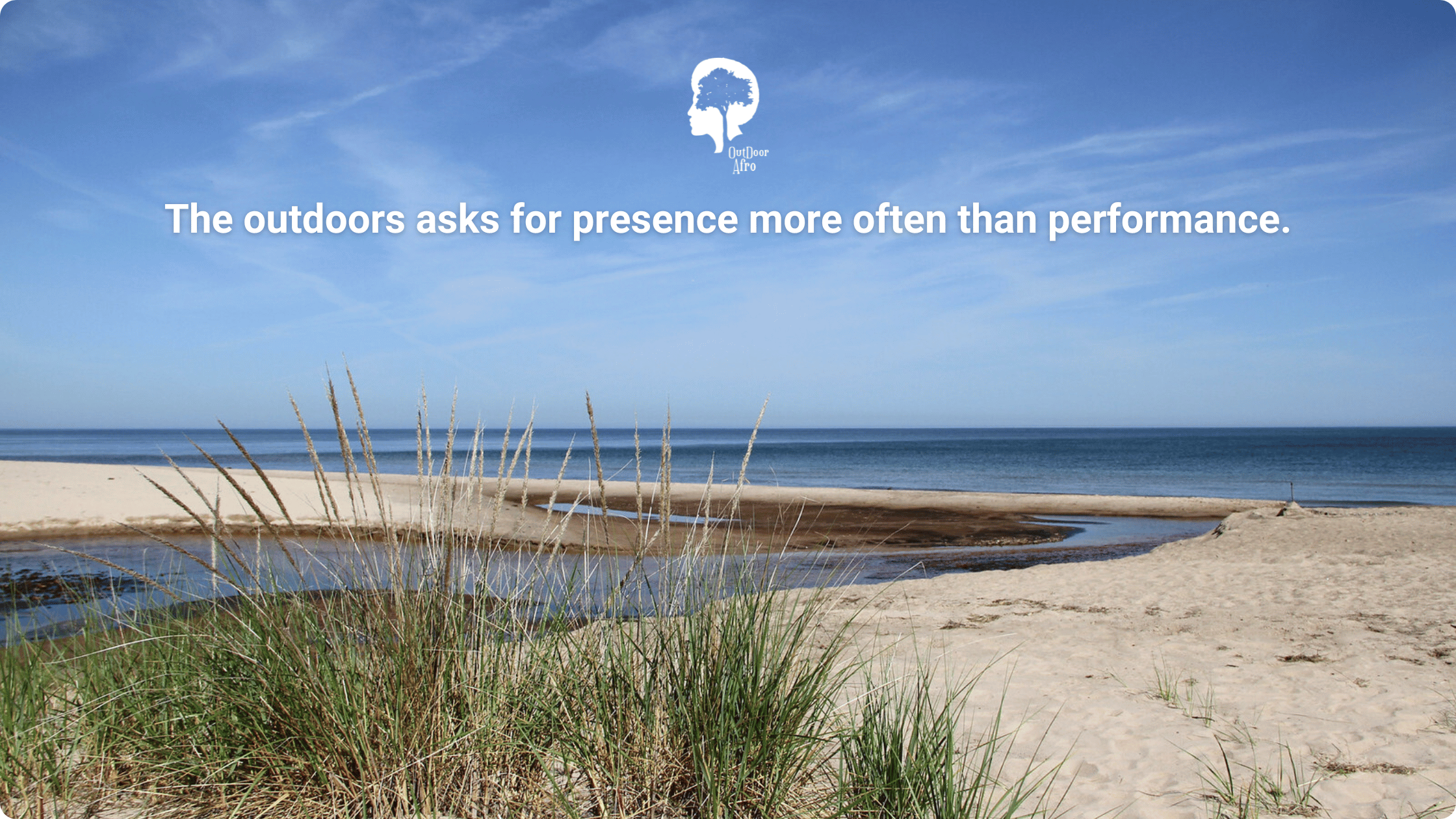
Not every form of wellness needs to photograph beautifully, and that may be part of its beauty. The outdoors asks for presence more often than performance.
Take a walk
The next step might be a walk around the block, down the street, through a nearby park, or along whatever route feels familiar enough to let your attention soften.
The walk does not have to become a workout. You do not have to track your pace, count your steps, think about burning calories, or turn it into another opportunity for self improvement. Walking can simply be a way to move through your own neighborhood at human speed and reconnect with a body that spends so much of the day sitting, working, driving, scrolling, carrying, or rushing.
A walk can be slow enough for conversation, slow enough for elders, and slow enough for children who need to stop every few yards to inspect a rock, a bug, a flower, or some mysterious object adults would otherwise pass without noticing. It can also be slow enough for someone who is tired but still wants to feel the sun. Movement can support physical wellbeing while also remaining pleasurable, social, curious, and ordinary.
Sometimes a walk is simply a walk, and that can be enough.
Gather somebody with you
Then there is the kind of wellness that happens when people gather.
A group of strangers might meet in a parking lot for a hike and, somewhere between the trailhead and the overlook, stop feeling quite so strange to one another. Somebody remembers extra water. Somebody has snacks. Somebody tells a story that makes the whole group laugh. Somebody is moving a little more slowly, so the pace changes without making a big production of it. By the end of the outing, names have become nicknames and people are exchanging numbers or talking about what they want to try next.
That counts as wellness, too.
Black communities have long practiced care through gathering. We have made room for one another in kitchens, on porches, beneath church roofs, beside grills, around card tables, at family reunions, and anywhere else people could arrive as their full selves and expect to be folded into the life of the group.
Outdoor Afro carries that same spirit outside.
On a trail, care may look like checking on the quiet person who has fallen a few steps behind. On the water, it may be showing somebody how to hold a paddle or cast a line. At a campsite, it may be helping a first timer figure out their tent before the sun goes down. Sometimes it is as simple as hearing, “You’re doing fine,” right when you need to hear it.
Community can turn unfamiliar activities into possible ones. It can make the first hike feel less intimidating, the first night outside feel safer, and the first attempt at something new feel like a story worth telling instead of a test you were expected to pass.
There is room for learning, uncertainty, laughter, and joy. There is room for somebody to know exactly what they are doing and somebody else to ask which end of the paddle goes where.
That is part of the experience.
Camp right where you are
You do not need to drive six hours into the wilderness to have an outdoor adventure.
We are proud to share our new national initiative, Little CampOut, that brings the spirit of camping closer to home because there’s something wonderful about an adventure that begins with what you already have.
Little CampOut makes room for families who cannot travel, people who have never camped before, households working with limited resources, and anyone who wants to experiment before committing to something bigger. It removes the idea that camping has to begin with a trunk full of expensive gear and a remote destination with no cell service, by recreating a virtual campfire with folks gathered round to share stories.
If you missed the last one, relive the stories here, and download the app to be sure you’ll be notified of the next one!
And when you’re ready, come farther with us
Because maybe eventually you’ll want something bigger…
Maybe after all these small steps you’ll find you want a trail that carries you somewhere you have never been, a river that asks you to learn a new rhythm, a fishing spot someone else loves enough to share, a garden you did not know was hidden in your own city, a campsite beneath unfamiliar stars, or a snowy hill that reminds you winter can be playful instead of merely cold.
Outdoor Afro outings offer a way to experience those possibilities through community. Across the country, trained Outdoor Afro Volunteers guide experiences that connect people with our lands and waterways through outdoor recreation, education, and conservation.
You may arrive knowing exactly what you are doing, or you may arrive wondering what you should wear and whether everyone else will somehow be more experienced than you.
Either way, there is room for you.
Belonging in nature is not something you earn by accumulating equipment, memorizing terminology, or proving how adventurous you are.
You can learn as you go.
You can ask questions.
You can move slowly.
You can be nervous.
You can laugh when you get something wrong.
You can discover that the activity you were sure would not be for you is suddenly the one you cannot stop talking about!
Come join us and see for yourself.
Wellness was never supposed to be another thing to achieve
When we say “we have wellness at home,” we are talking about more than a physical address.
The wellness industry can keep offering its beautiful versions of wellbeing, and some of them may serve us well (no pun intended…okay maybe a little), but Outdoor Afro keeps pointing toward something older, closer, and much harder to put a price on: the living world around us, the communities that help us feel at home within it, and the ordinary practices that bring us back into relationship with our bodies, one another, and the earth beneath our feet.
You do not have to overhaul your routine to begin. You might start by taking your morning coffee outside. You might breathe beneath a tree, walk around the block, sit beside a creek, put a tent in the backyard, borrow a pair of binoculars, learn how to cast a line, or join an Outdoor Afro outing and discover that your first time can still feel like a return.
You got this and we got you.
See you outside.
Cited sources:
[1] Chevalier, “The Effect of Grounding the Human Body on Mood.” PubMed
[2] “Effect of breathing exercises on blood pressure and heart rate: A systematic review and meta-analysis.” PubMed
[3] Jimenez et al., “Associations between Nature Exposure and Health: A Review of the Evidence.” PubMed Central (PMC)
[4] “Blood pressure-lowering effect of Shinrin-yoku (Forest bathing): a systematic review and meta-analysis.” PubMed Central (PMC)