This Fall, Come Outside and Stay Awhile
This Fall, Come Outside and Stay Awhile
Let Autumn Meet You Where You Are
We’re excited about all the autumn-y things. Except we also know that autumn may look different, depending on where you live, than the super specific one all over social media right now…
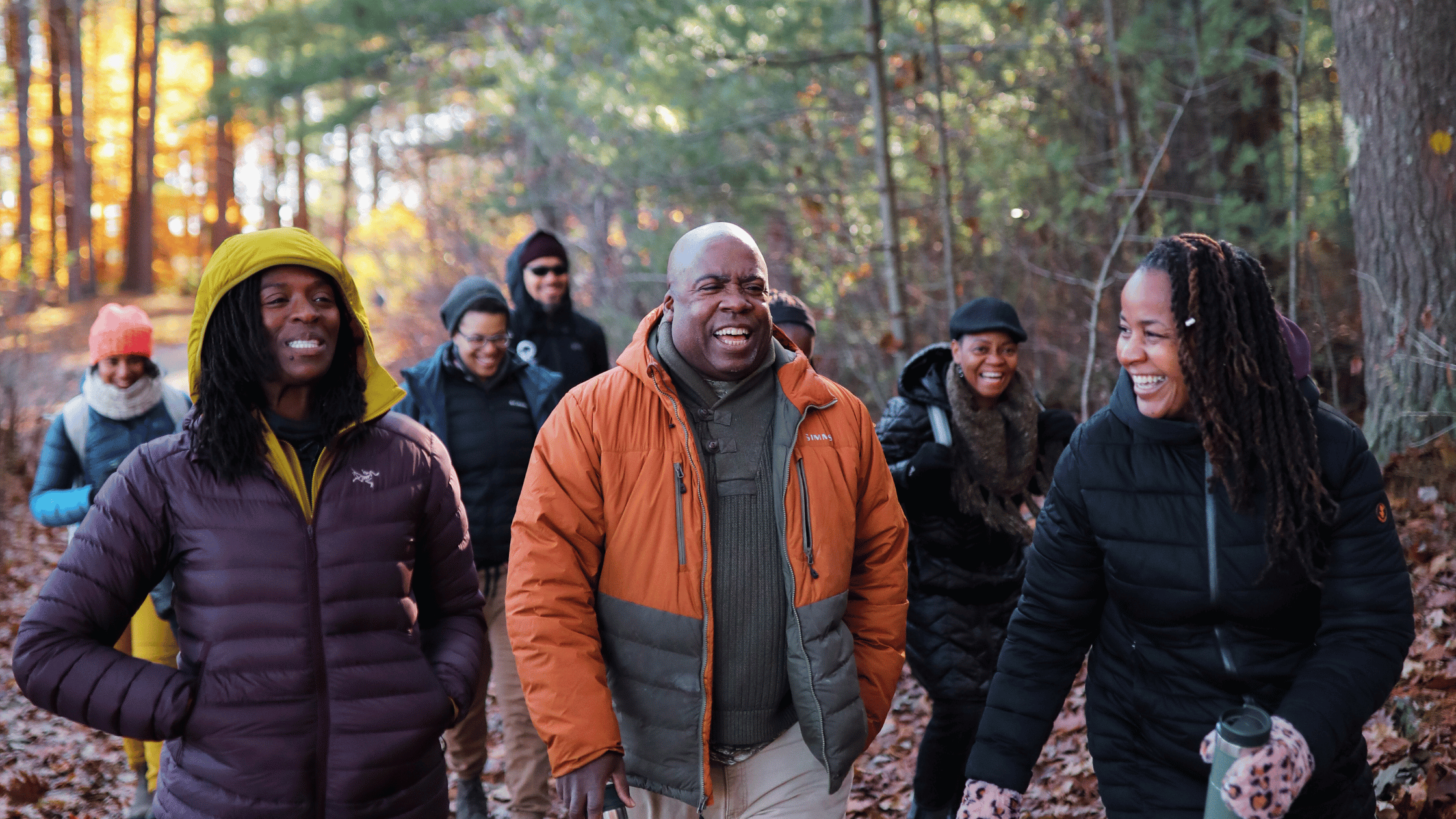
Maybe you’re in New England, where the trees seem to wake up one morning and decide to put on a show, turning familiar hillsides red, orange and gold until even your regular neighborhood walk feels special.
Maybe you’re in the Pacific Northwest, where autumn arrives with mist between the evergreens, mushrooms tucked beneath the trees and that unmistakable smell of rain hitting the earth.
Maybe you’re in the South, watching everyone else pull out sweaters while you’re still waiting patiently for a morning cool enough to justify one.
Or maybe you’re in Southern California, Florida or the desert Southwest, where fall has very little interest in performing the traditional orange leaf routine and instead shows up in softer light, cooler evenings, migrating birds, changing tides or the simple pleasure of realizing you can finally spend a few more hours outside without planning your entire day around the heat!
That’s one of our favorite things about being outdoors: nature has never been particularly interested in following somebody else’s calendar.
And neither should you have to.
At Outdoor Afro, we believe the outdoors can meet you exactly where you are, and autumn is a lovely time to practice letting it. You don’t need to fly across the country chasing peak foliage, buy a whole new collection of gear, climb a mountain before breakfast or turn “wellness” into another project you have to be good at.
You can just go outside.
Really. We can start there.
Your autumn can begin right outside your front door, with a walk after dinner simply because the evening feels too beautiful to spend indoors, or with your Saturday morning coffee carried to a favorite park bench with a good view. Call the friend you’ve been meaning to catch up with and walk while you talk, bring the kids along and let them investigate every interesting leaf, rock and stick they find (even if y’all end up going slower than snails) or take the dog somewhere new and let yourselves wander following one very enthusiastic nose. Autumn doesn’t need much planning to become something special; sometimes all it takes is giving yourself a reason to linger outside a little longer than usual.
And if all that still seems like a lot, then maybe you go alone.
No pace to maintain, no conversation to carry, no reason to turn the experience into anything more impressive than it is. Just you, a little fresh air and enough time to notice what has changed since the last time you really looked around.
If you live somewhere famous for fall color, absolutely enjoy it. Go find the maples. Take the pictures. Walk underneath trees that look like they’ve been lit from within and marvel at the fact that they do this every year for free.
But if the trees around you are still stubbornly green, you haven’t missed autumn.
Look for your version.
Start Easy. You Can Always Keep Going.
One of the easiest ways to make the outdoors feel like part of your life is to stop requiring every outing to qualify as an Adventure with a capital A.
A walk counts.
Sitting beside the water counts.
Reading beneath a tree counts.
Taking your lunch outside because the sun feels good counts.
And there is something lovely that happens when you begin there, because once being outside feels ordinary, curiosity tends to take care of the rest.
That little neighborhood walk might eventually turn into a Saturday morning hike. The hour you planned to spend at the park might become an afternoon once you remember to bring lunch. You might rent a bicycle and see where the greenway goes, join a fall birding walk, paddle a calm lake while the shoreline changes around you, visit a state park you keep passing on road trips or gather a few friends for an outdoor meal where everyone brings something and nobody is in much of a hurry to leave.
This is also a good time to remember that movement is allowed to feel good.
Your body does not need to be a project before it can become your companion outdoors. It is already your golden ticket, carrying you into all of this. It lets you feel cold air in your lungs and sun on your face.
Sometimes wellness can be as simple as remembering that it feels good to be a person with a body in the world.
And other times, wellness can mean taking it slow and sitting down.
Seriously, don’t forget to sit down and stay awhile!
You made it out in nature. Let yourself enjoy it when you:
- Stay there long enough to watch the light change.
- Bring a thermos.
- Pack something delicious.
- Stretch out on a blanket.
- Take your shoes off if the setting allows it.
- Listen to the sounds around you until you stop treating them as background noise.
There is no prize waiting for the person who enjoyed nature most efficiently. Sometimes the best ten minutes of a hike are the ten minutes when nobody is hiking.
And If You’re Feeling Adventurous…
Maybe this is the autumn when you try something you’ve quietly been curious about for years.
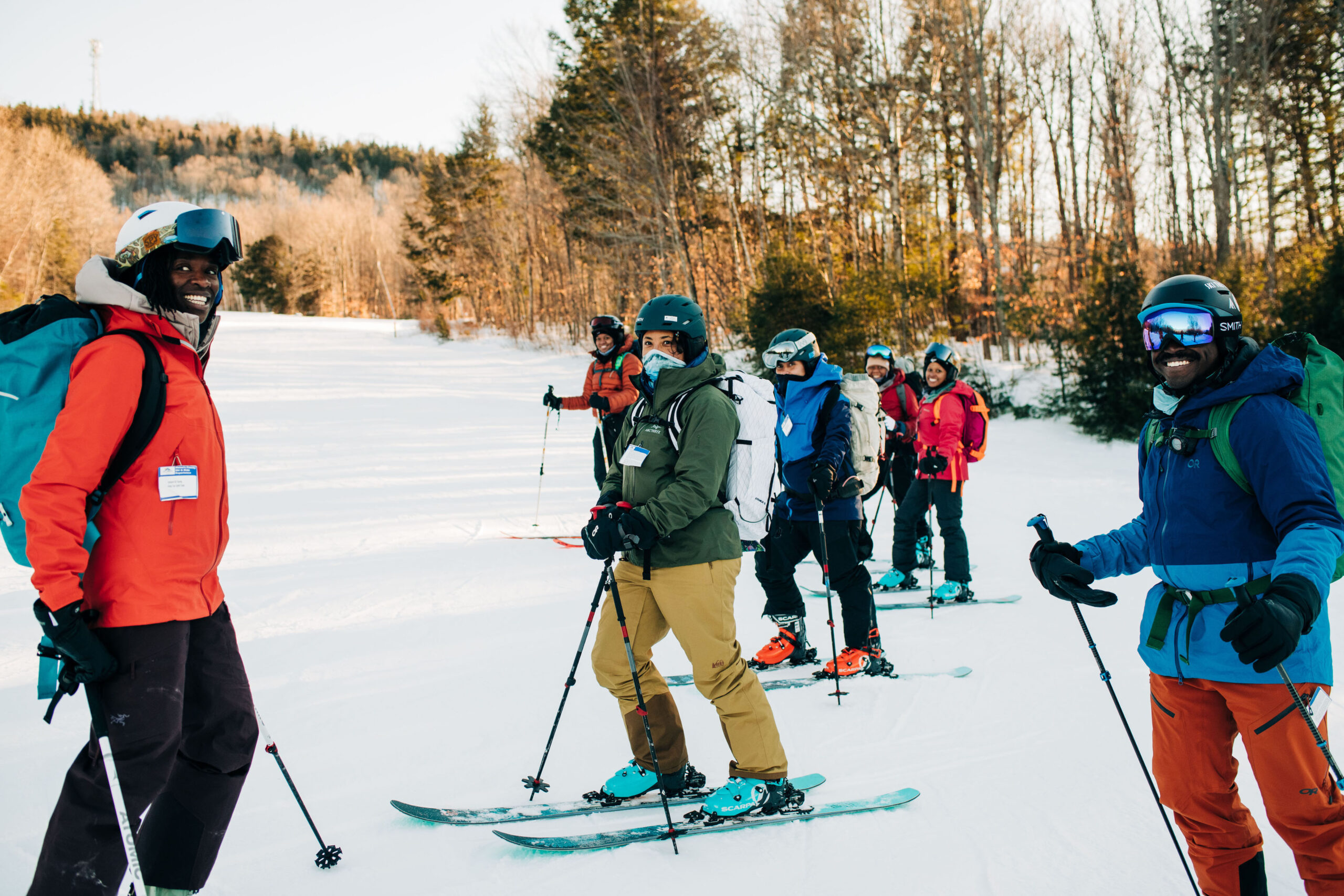
Perhaps you’ve watched people hike longer trails and wondered whether you could do it. Maybe you’ve always wanted to camp, but your family simply wasn’t a camping family and nobody ever taught you where to begin. Or you keep seeing people mountain biking and think to yourself, Okay, that does look like fun… Maybe you want to try climbing. Maybe you want to put on a helmet and life jacket and find out why people voluntarily get into a raft headed toward whitewater.
You are allowed to be new at things.
In fact, being new can be half the fun when you embrace it by:
- Choosing the most manageable hike
- Taking your first camping trip somewhere close enough to civilization that forgetting something doesn’t become a grand survival narrative
- Finding the beginner bike trail.
- Going rafting with trained guides and enjoy the wonderful luxury of having somebody else understand the river while you concentrate on paddling, laughing and staying in the boat.
You don’t have to become an “outdoors person” before you do outdoorsy things, because after all you become experienced by having experiences!
And doing it with community can make that first step feel a whole lot easier. There is something special about looking around on a trail, in a kayak, beside a campfire or inside a raft and realizing that nobody needs an explanation for why you’re there.
You belong in the picture because you showed up.
Wellness Doesn’t Need to Become Another Job
This may be our favorite autumn reminder.
There is a version of “wellness” that can become exhausting very quickly.
Wake up earlier. Work out harder. Eat perfectly. Drink more water. Optimize your sleep. Track this. Improve that. Buy the thing. Start the routine. Become a better version of yourself by Tuesday.
That is a lot.
Nature offers us a very different rhythm, especially in these autumn months. Shorter days aren’t simply “failed” longer days. A tree dropping its leaves isn’t falling behind. The landscape is always changing pace, putting energy somewhere new, letting something go, becoming quiet, beginning again.
We can borrow a little of that permission.
So your autumn wellness might be a challenging hike because you woke up with energy to burn and want to see what your legs can do. The following weekend, it might be the easy trail because work was a lot and you would rather wander slowly and look at birds.
Both count.
Just like it might be taking your headphones out for one walk so you can hear your own footsteps, then putting them right back in the next day because your favorite album sounds especially good beneath the trees.
You are allowed to ask yourself a much kinder question than What should I be doing?
Try:
What would feel good today?
Or:
What do I need?
Then see which word comes to mind first and feels best:
- Movement
- Community
- Solitude
- Adventure
- Relaxation
Your Autumn Is Already Out There
Some of us are going to spend the next few months beneath trees so colorful they barely look real. Some of us will be walking through evergreens in the rain. Some will watch cottonwoods turn gold against enormous Western skies. Some will paddle through cypress country, wander beaches newly quiet after summer, hike desert trails that are finally comfortable again, bike city greenways, climb mountains, sit beside rivers or simply step outside one evening and think, Oh. There you are, fall.
There is no single correct way to enjoy this season, just as there is no single correct way to take care of yourself.
You can start with ten minutes outside. You might eventually end up near a river.
You can walk around the block today and climb the mountain next year. You can climb the mountain today and spend tomorrow happily under a blanket while you watch the trees move outside your window.
You do not have to prove that you belong outdoors… you already do, and you always have.
So let autumn meet you where you are. And somewhere between the first cool morning and the end of the season, whether that season finds you beneath blazing maples, towering pines, live oaks, redwoods, dreamy palms or an enormous desert sky, you may realize that taking care of yourself did not require becoming somebody new.
Maybe you just needed a little air.
Come outside. We’ll meet you there, just as you are.
And if you could use a little outdoor time right now, wherever you happen to be, come take a hike with us. Our hiking visualization podcast episode lets you close your eyes and follow the trail through the sights, sounds and sensations of the outdoors, with you at the center of the adventure. Think of it as a little nature break for the days when getting outside isn’t quite in the cards, and perhaps a spark of inspiration for the next day when it is.

We Have Wellness At Home
We Have Wellness At Home
Wellness has become a booming industry, and booming industries have a sneaky way of wandering away from the very things that gave them meaning in the first place.
Search #wellness on social media and you will probably encounter color coordinated yoga outfits, immaculate morning routines, expensive retreats, aesthetic water bottles, supplements, saunas, spas, and people who appear to have somehow eliminated to-do lists, deadlines, and dirty dishes from their daily lives. Before long, wellness can start to feel like just another thing we are expected to purchase and perfect before we are allowed to enjoy any of its benefits.
Some of those things can be lovely, after all beauty and ritual have always belonged to us. There is nothing wrong with a beautiful yoga mat, a boujee candle, or a fancy spa day that helps you feel grounded. But fancy is optional, especially when it comes with a price tag, and wellness should never become another standard we have to meet before we are permitted to feel good in our own bodies and lives.
So before the back-to-school rush gives way to the back-to-back holidays and all their built-in busyness, we’d like to invite you to think about wellness a little differently. Not as something you have to earn, but as something you can practice right where you are. Not as an elaborate reinvention of your life, but as a series of small ways to reconnect with yourself, your community, and the natural world around you.
We’ll start with the simplest possibilities and move gradually toward bigger ones, because caring for ourselves can begin with five minutes outside just as surely as it can begin on a hike.
But first, let’s go back to the beginning.
A natural history
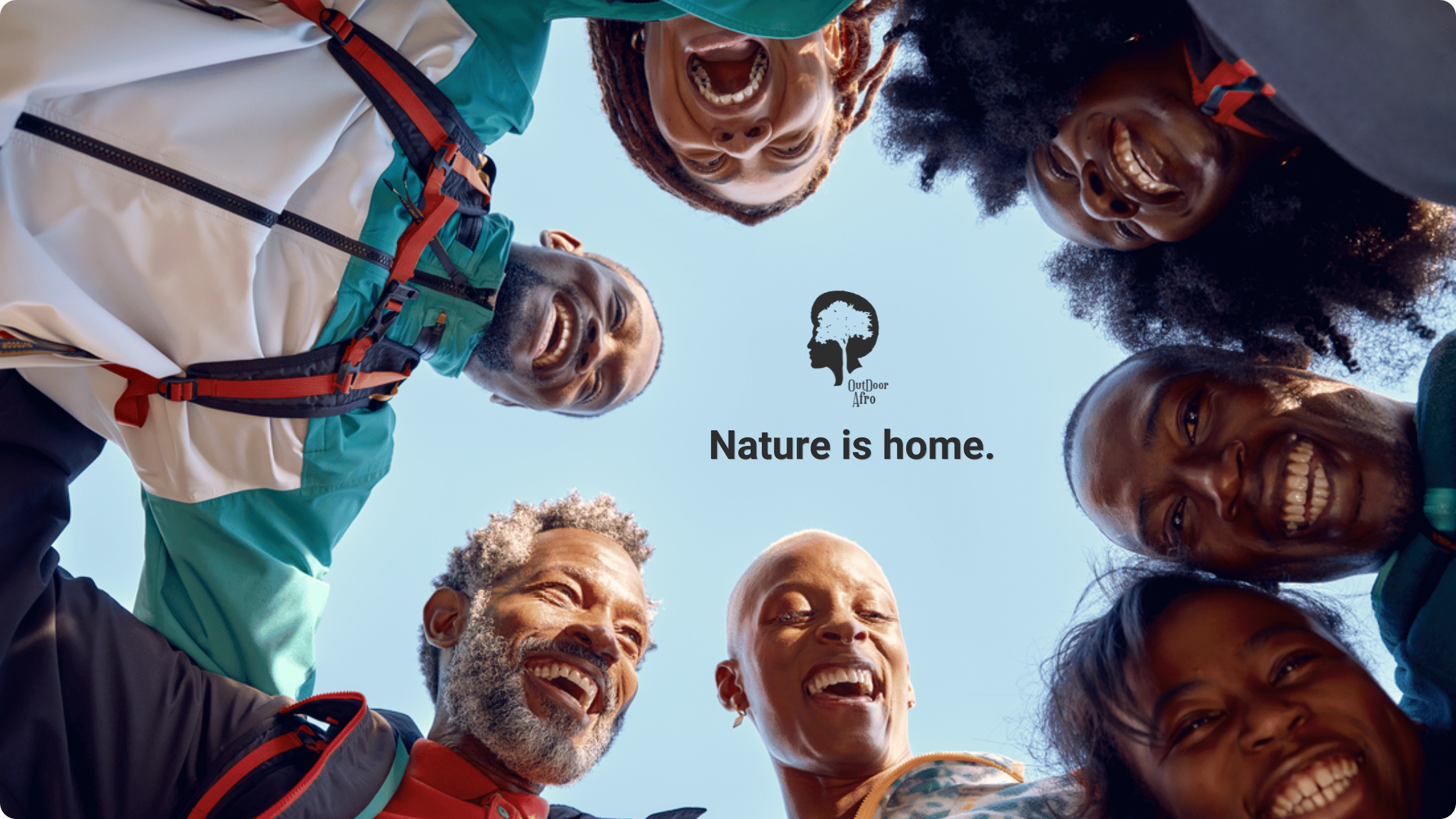
Outdoor Afro was founded 17 years ago to celebrate and inspire Black connections to and in nature, and that mission begins with a truth many of us already know somewhere deep in the body: nature is not a luxury waiting for us at the end of achievement. Nature is home.
It’s the park and the creek, the trail, the lake, the trees and the birds moving across the morning sky with absolutely no concern for whatever is happening in the news.
Nature is present not only around us, but in the memories that shaped us. It’s greens being washed in the sink, the auntie whose houseplants are lined up like favorite cousins, the family reunion beneath a great tree, the uncle who knows where the fish bite, and the little kids running toward an open patch of grass because their bodies seem to understand the need for nature before ever thinking too deeply about it.
For many of us, connection with nature is already woven into the ordinary textures of life, even if we have never described those experiences as “outdoor recreation.” Maybe nobody in the family owned technical hiking boots, but there were afternoons in the yard, cookouts in the park, fishing trips, walks after dinner, stoop conversations under a summer sky, or long drives toward somebody’s favorite piece of land. Nature has always had a way of appearing around the edges of our lives, reminding us that the outdoors is not somewhere we have to travel to become worthy of entering.
But modern wellness can sometimes make us feel as though we need to become someone else before we begin. Outdoor Afro offers another possibility: reconnecting with something that has already been ours, even when we are experiencing it in a completely new way.
Maybe that looks like joining an Outdoor Afro outing and climbing into a kayak for the first time, learning how to hold a paddle and discovering the delicate balance between your body, the boat, and the water. Or maybe it’s casting a fishing line for the first time and learning that patience really is a virtue, while also discovering that sitting quietly beside a creek can be its own kind of rest. Or maybe you give birding a chance and realize that simply paying attention can transform an ordinary patch of sky into a neighborhood full of extraordinary feathered friends.
At the beginning, you might not know the names of the gear, the rules of the activity, or the rhythm of the group yet. None of that disqualifies you. Expertise can come later. Confidence can come later. Belonging does not have to.
You are already home.
Start with five minutes outside
Wellness can begin with something almost absurdly simple: open the door.
Alright, you’re all inspired now and ready to delve into wellness, well where to begin? Step outside and give yourself a moment before deciding what you are supposed to do next. Feel the temperature on your skin. Look up at the sky. Find something green. Notice where the light lands. Listen first for the loudest sound around you, then for the quietest one. There is no performance required and no particular insight you have to achieve. The simple act of noticing can be enough.
If it feels comfortable and safe, take off your shoes for a few minutes and let your feet meet grass, sand, soil, or another natural surface. Research into “grounding,” or direct physical contact with the earth, is still emerging, with small studies exploring possible positive effects on mood and physical wellbeing. [1] That means it is best approached with curiosity rather than big promises. You do not need to believe that standing barefoot in the grass will cure anything in order to appreciate the simple pleasure of cool ground beneath your feet, the slight unevenness of soil, or the feeling of sand shifting underneath your weight.
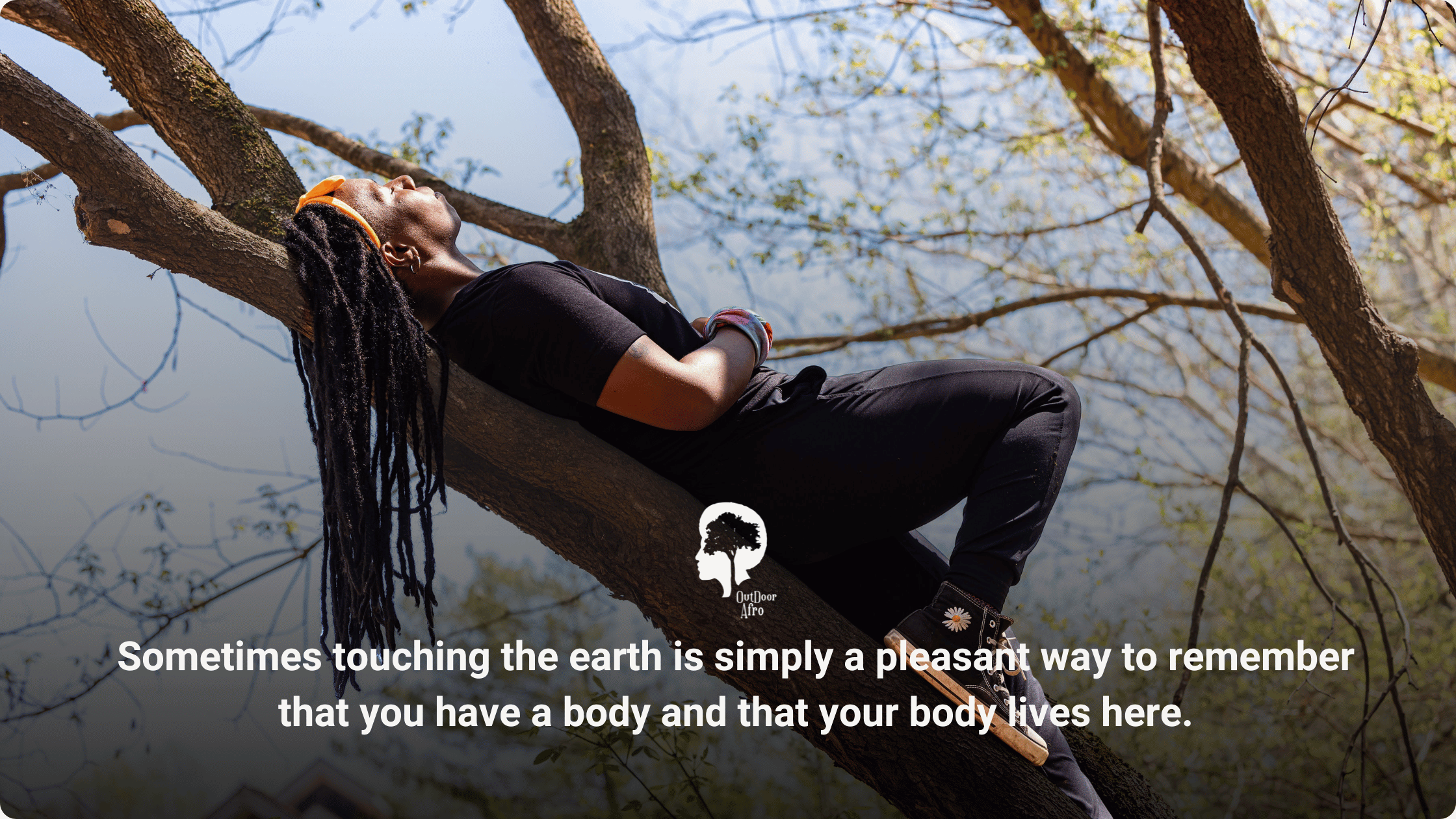
Sometimes touching the earth is simply a pleasant way to remember that you have a body and that your body lives here.
From there, let your attention move toward your breath. Take one breath that reaches a little deeper than the ones you were taking indoors. Let the exhale stretch gently longer than the inhale and notice whether your shoulders soften on their own. Breathing practices have been studied for their effects on stress, blood pressure, heart rate, and other biomarkers of a happy nervous system. [2] Outside, breathing can feel less like another wellness assignment and more like part of the landscape itself, with air moving through leaves, into your lungs, and back into the world.
You are not optimizing anything. You are simply outside, breathing air, noticing where you are, and allowing that to be enough for a few minutes.
Stay long enough to notice something
If five minutes feels good, let the moment widen.
Stand beneath a tree, wander slowly through a park, sit beside water, or try a little forest bathing by moving without rushing and letting your senses lead. Forest bathing does not require any particular equipment or level of expertise. At its simplest, it is an invitation to spend time among trees and pay deliberate attention to what you can see, hear, smell, and feel.
Notice the temperature and the pattern of light on the sidewalk. Pay attention to the smell of grass after rain or the texture of bark beneath your hand. Listen to the way leaves move when the wind passes through them. Watch insects doing their tiny, serious work. Notice how much life is carrying on around you without asking you to solve, improve, or accomplish anything.
Research into nature exposure and practices such as forest bathing has associated time in green spaces with benefits related to stress, blood pressure, sleep, physical activity, and mental wellbeing. [3] [4] But the appeal does not have to live entirely in the research. There is also something wonderfully uncomplicated about spending time in a place where your only responsibility for a few minutes is to notice what is already happening.
Maybe you went outside feeling wound up and came back a little calmer. Maybe nothing dramatic happened at all, but you noticed a bird you had never seen before. Maybe your mind wandered in ten directions and then, for one small moment, landed on the sound of rain against leaves.
That counts.
Not every form of wellness needs to photograph beautifully, and that may be part of its beauty. The outdoors asks for presence more often than performance.
Take a walk
The next step might be a walk around the block, down the street, through a nearby park, or along whatever route feels familiar enough to let your attention soften.
The walk does not have to become a workout. You do not have to track your pace, count your steps, think about burning calories, or turn it into another opportunity for self improvement. Walking can simply be a way to move through your own neighborhood at human speed and reconnect with a body that spends so much of the day sitting, working, driving, scrolling, carrying, or rushing.
A walk can be slow enough for conversation, slow enough for elders, and slow enough for children who need to stop every few yards to inspect a rock, a bug, a flower, or some mysterious object adults would otherwise pass without noticing. It can also be slow enough for someone who is tired but still wants to feel the sun. Movement can support physical wellbeing while also remaining pleasurable, social, curious, and ordinary.
Sometimes a walk is simply a walk, and that can be enough.
Gather somebody with you
Then there is the kind of wellness that happens when people gather.
A group of strangers might meet in a parking lot for a hike and, somewhere between the trailhead and the overlook, stop feeling quite so strange to one another. Somebody remembers extra water. Somebody has snacks. Somebody tells a story that makes the whole group laugh. Somebody is moving a little more slowly, so the pace changes without making a big production of it. By the end of the outing, names have become nicknames and people are exchanging numbers or talking about what they want to try next.
That counts as wellness, too.
Black communities have long practiced care through gathering. We have made room for one another in kitchens, on porches, beneath church roofs, beside grills, around card tables, at family reunions, and anywhere else people could arrive as their full selves and expect to be folded into the life of the group.
Outdoor Afro carries that same spirit outside.
On a trail, care may look like checking on the quiet person who has fallen a few steps behind. On the water, it may be showing somebody how to hold a paddle or cast a line. At a campsite, it may be helping a first timer figure out their tent before the sun goes down. Sometimes it is as simple as hearing, “You’re doing fine,” right when you need to hear it.
Community can turn unfamiliar activities into possible ones. It can make the first hike feel less intimidating, the first night outside feel safer, and the first attempt at something new feel like a story worth telling instead of a test you were expected to pass.
There is room for learning, uncertainty, laughter, and joy. There is room for somebody to know exactly what they are doing and somebody else to ask which end of the paddle goes where.
That is part of the experience.
Camp right where you are
You do not need to drive six hours into the wilderness to have an outdoor adventure.
We are proud to share our new national initiative, Little CampOut, that brings the spirit of camping closer to home because there’s something wonderful about an adventure that begins with what you already have.
Little CampOut makes room for families who cannot travel, people who have never camped before, households working with limited resources, and anyone who wants to experiment before committing to something bigger. It removes the idea that camping has to begin with a trunk full of expensive gear and a remote destination with no cell service, by recreating a virtual campfire with folks gathered round to share stories.
If you missed the last one, relive the stories here, and download the app to be sure you’ll be notified of the next one!
And when you’re ready, come farther with us
Because maybe eventually you’ll want something bigger…
Maybe after all these small steps you’ll find you want a trail that carries you somewhere you have never been, a river that asks you to learn a new rhythm, a fishing spot someone else loves enough to share, a garden you did not know was hidden in your own city, a campsite beneath unfamiliar stars, or a snowy hill that reminds you winter can be playful instead of merely cold.
Outdoor Afro outings offer a way to experience those possibilities through community. Across the country, trained Outdoor Afro Volunteers guide experiences that connect people with our lands and waterways through outdoor recreation, education, and conservation.
You may arrive knowing exactly what you are doing, or you may arrive wondering what you should wear and whether everyone else will somehow be more experienced than you.
Either way, there is room for you.
Belonging in nature is not something you earn by accumulating equipment, memorizing terminology, or proving how adventurous you are.
You can learn as you go.
You can ask questions.
You can move slowly.
You can be nervous.
You can laugh when you get something wrong.
You can discover that the activity you were sure would not be for you is suddenly the one you cannot stop talking about!
Come join us and see for yourself.
Wellness was never supposed to be another thing to achieve
When we say “we have wellness at home,” we are talking about more than a physical address.
The wellness industry can keep offering its beautiful versions of wellbeing, and some of them may serve us well (no pun intended…okay maybe a little), but Outdoor Afro keeps pointing toward something older, closer, and much harder to put a price on: the living world around us, the communities that help us feel at home within it, and the ordinary practices that bring us back into relationship with our bodies, one another, and the earth beneath our feet.
You do not have to overhaul your routine to begin. You might start by taking your morning coffee outside. You might breathe beneath a tree, walk around the block, sit beside a creek, put a tent in the backyard, borrow a pair of binoculars, learn how to cast a line, or join an Outdoor Afro outing and discover that your first time can still feel like a return.
You got this and we got you.
See you outside.
Cited sources:
[1] Chevalier, “The Effect of Grounding the Human Body on Mood.” PubMed
[2] “Effect of breathing exercises on blood pressure and heart rate: A systematic review and meta-analysis.” PubMed
[3] Jimenez et al., “Associations between Nature Exposure and Health: A Review of the Evidence.” PubMed Central (PMC)
[4] “Blood pressure-lowering effect of Shinrin-yoku (Forest bathing): a systematic review and meta-analysis.” PubMed Central (PMC)
Campout Collab – Outdoor Afro x Latino Outdoors
Campout Collab – Outdoor Afro x Latino Outdoors
Building Community, Wellness, and Belonging Through Camping
Some of the best stories begin around a campfire.
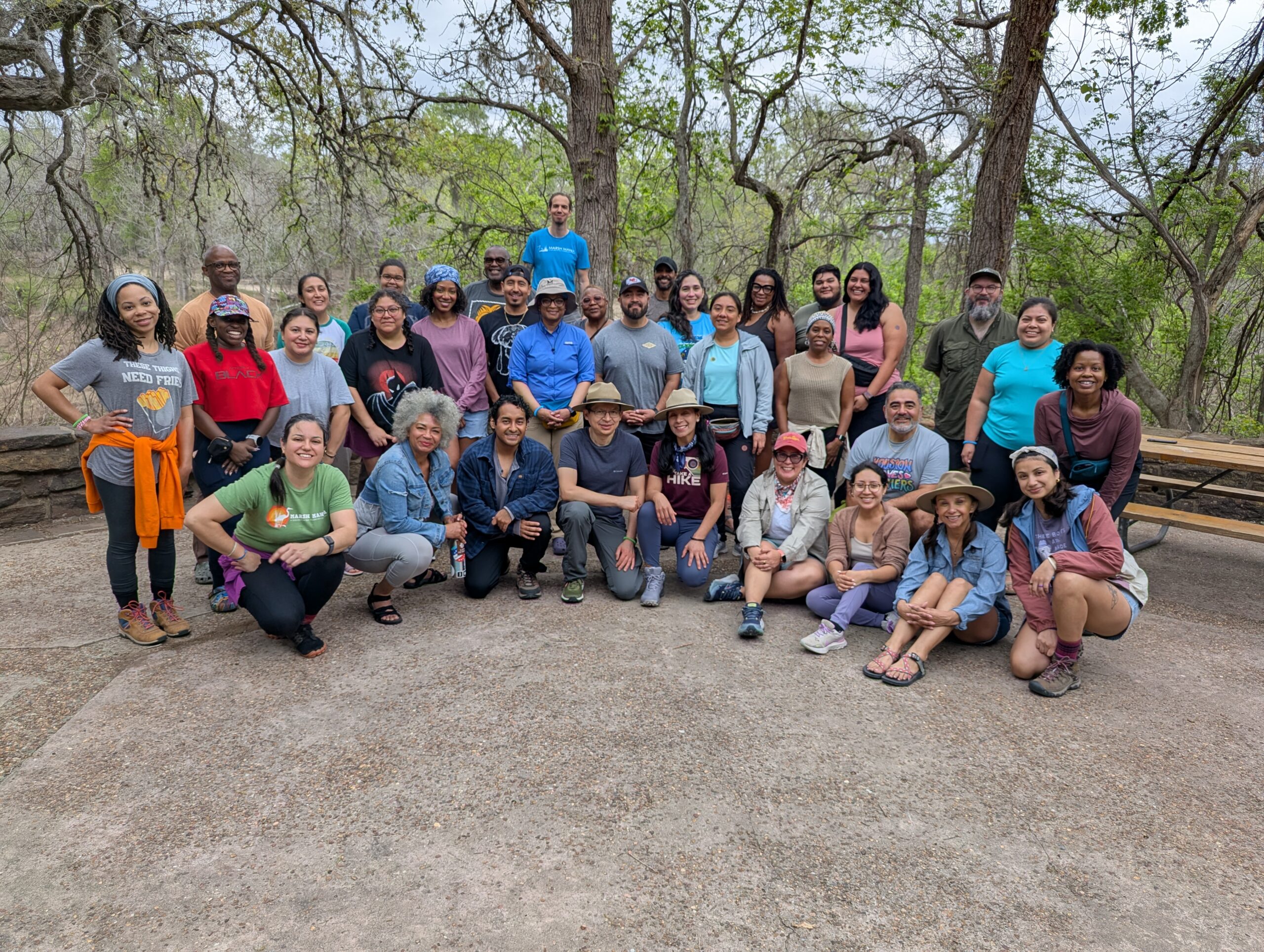
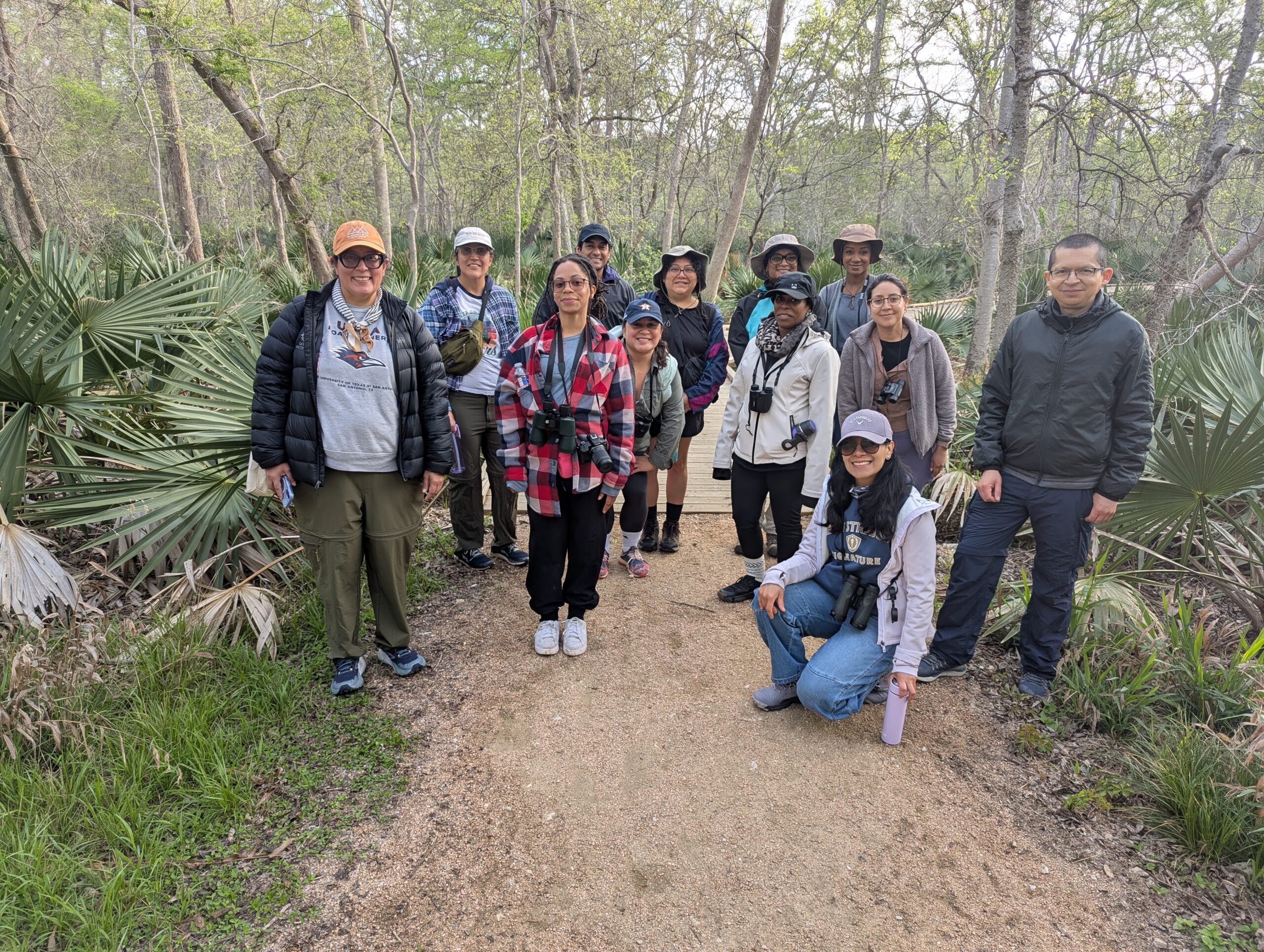
This year, Outdoor Afro and Latino Outdoors embarked on a beautiful journey together, bringing Black and Latino communities into nature through a series of multi-day camping experiences centered around wellness, leadership, and belonging. From Houston to the San Francisco Bay Area and the Chicago region, participants gathered under one shared vision: that the outdoors is a place where our communities can reconnect, learn, and thrive, together.
What unfolded across these campouts was a living reminder that our stories, cultures, and traditions have always been connected to the land and to one another.
Every stop along the way added another chapter to that story.

CHAPTER 1: HOUSTON
Making Space for Wellness
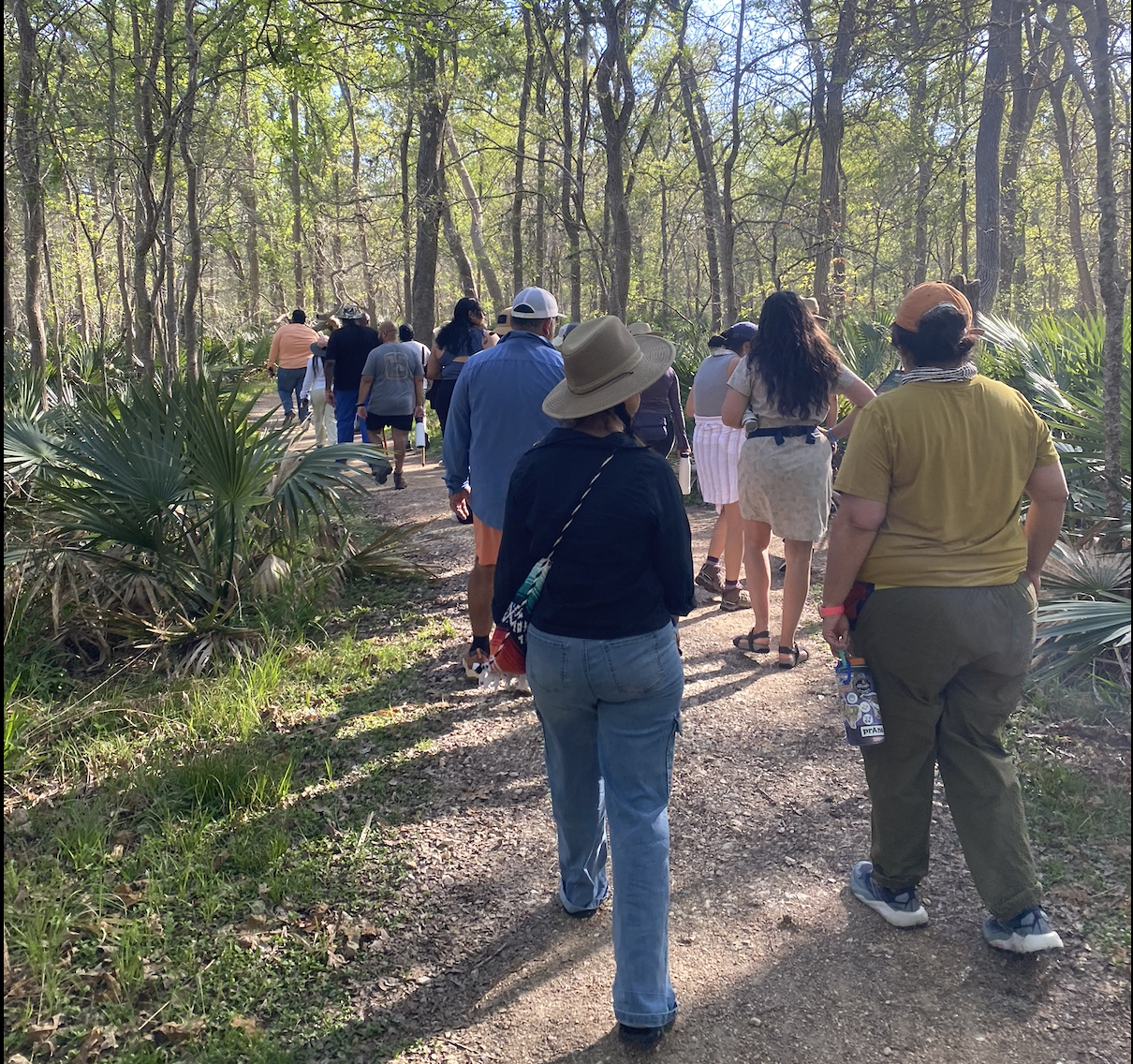
At Palmetto State Park outside Houston, the importance of gathering together felt especially profound.
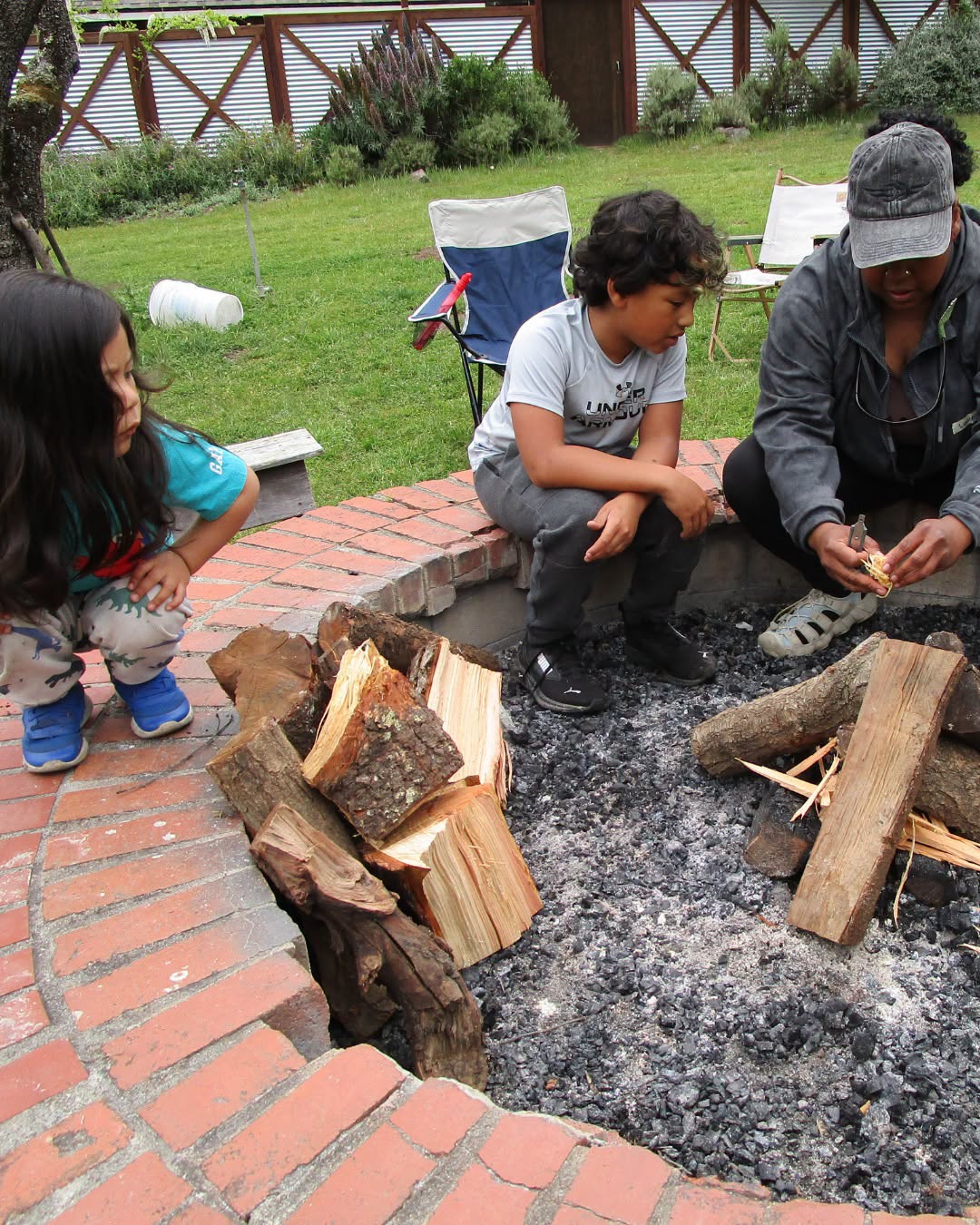
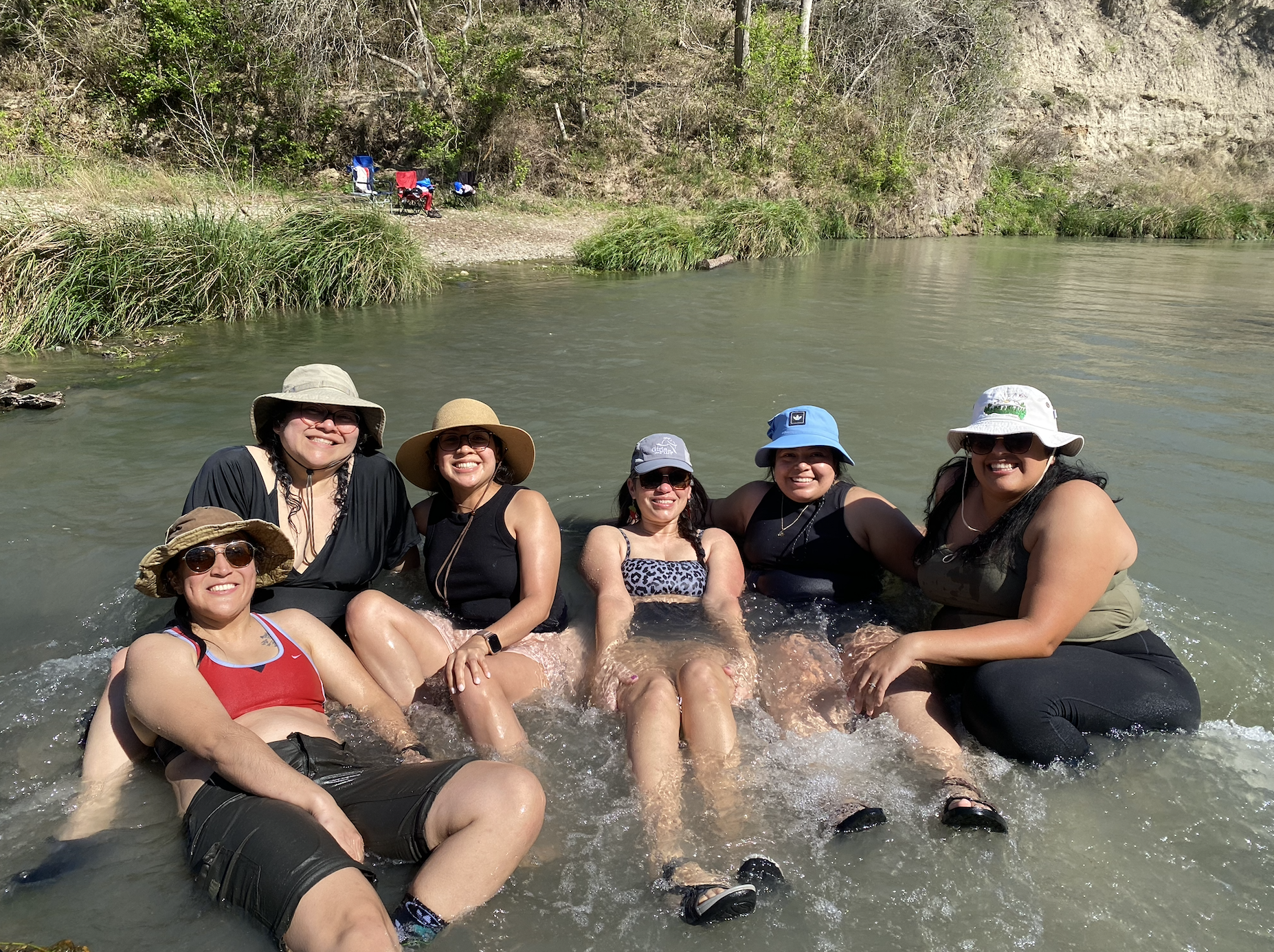
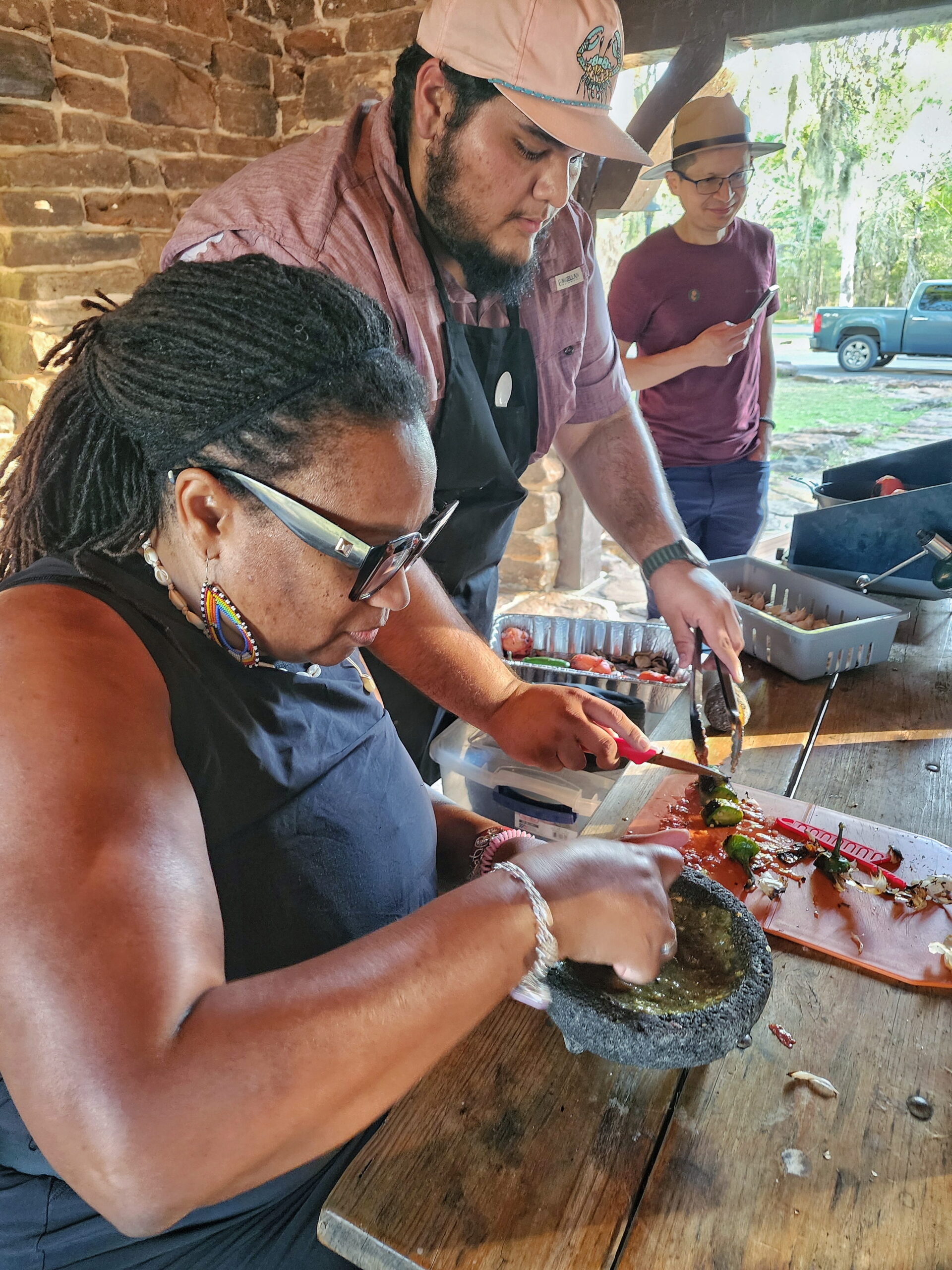
Participants made molcajete salsa and shared discada tacos. They learned about the African roots that shape so much of Latin American music and danced together in celebration of those shared histories. They learned to build campfires, floated in the river, and looked up at the stars together.
Around the evening fire, stories emerged about family traditions, ancestors, and the connections built over the course of the weekend. Others spoke about the importance of unity, kinship, the healing power of nature, and how meaningful it is to be in a space where we can simply be ourselves. Iliana Alviter, of Latino Outdoors remarked:
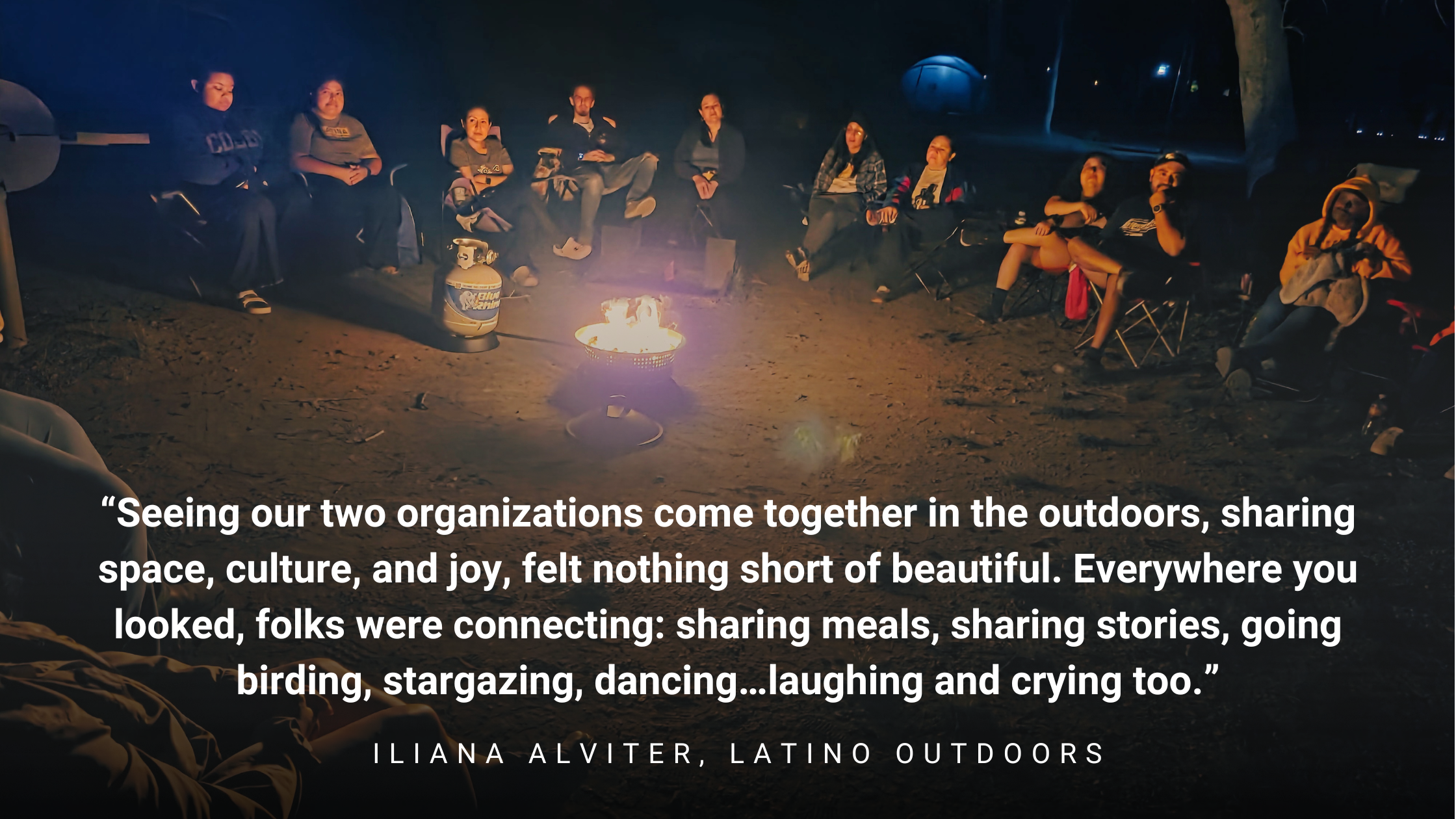
Again and again, people spoke about the healing that happens when we are able to simply be ourselves, and this weekend offered a powerful reminder: joy is not separate from the work—it is part of the work.
CHAPTER 2: SAN FRANCISCO BAY AREA
Finding Magic, Rain or Shine
The Bay Area campout taught another lesson entirely…
The rain came, but so did everyone else.
Nobody allowed the weather to interrupt what had been months of planning and anticipation. Instead, participants adapted together, finding new ways to enjoy nature. Astronomy presentations moved indoors. Movie nights appeared. Arts and crafts tables emerged. Families gathered in community spaces, played Lotería and Taboo, shared meals, and made memories that had nothing to do with perfect weather.
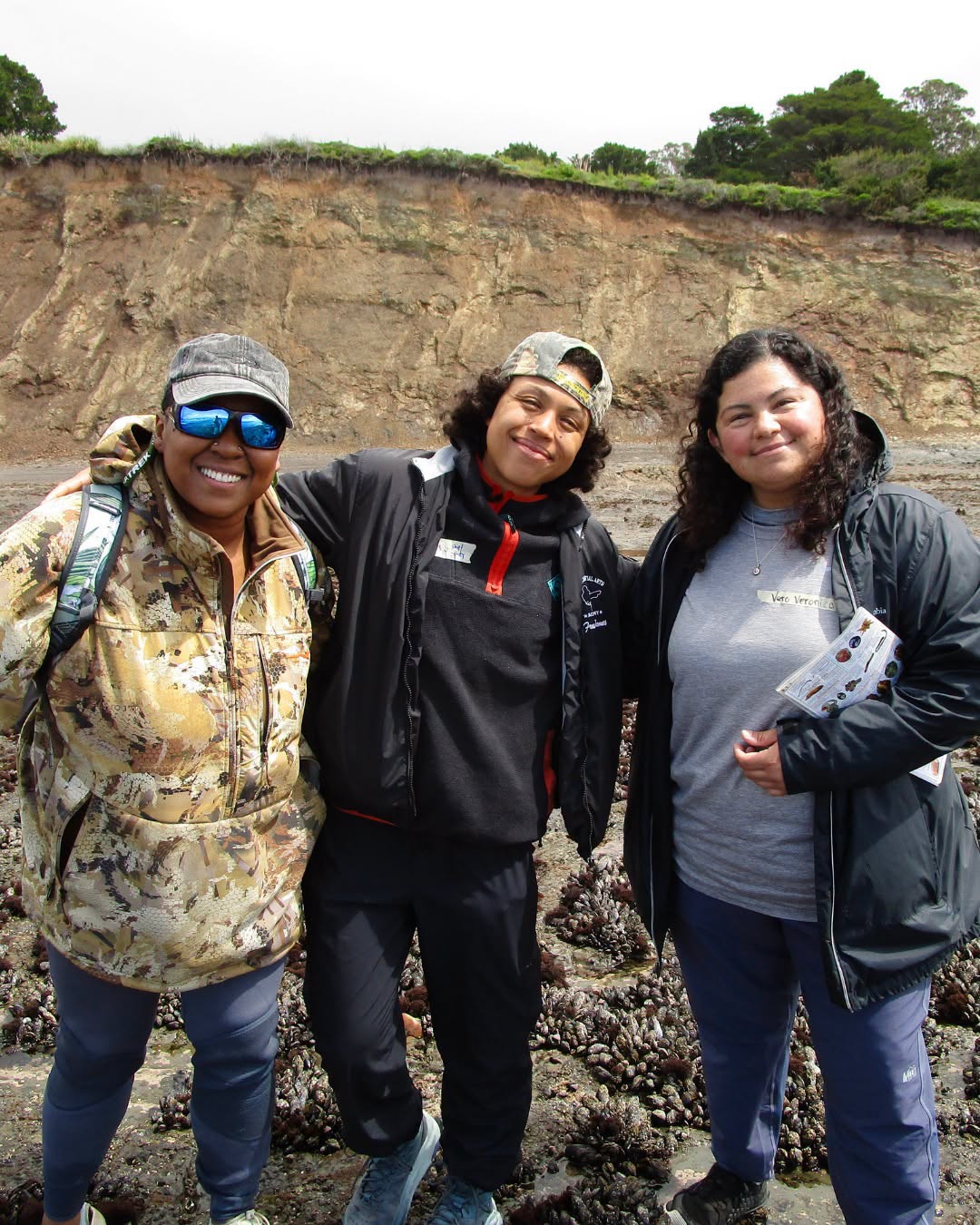
When the skies opened, hikers headed for the trails and explored the tide pools together.
Perhaps the most beautiful moments came through the connections between generations. Children played with elders, young adults found community with families, parents watched new friendships form in every direction.
Latino Outdoors’ SF Bay Area Regional Coordinator, Aurora Cortes, reflected:
“Our community campout in partnership with Outdoor Afro was a huge success! It rained on us, but even the rain wasn’t enough to keep people from camping! Our closing circle got very emotional with people expressing their immense gratitude for a safe space… It was all just really good vibes.”
The gathering became a reminder that belonging isn’t built by ideal circumstances. It is built by people choosing to care for one another, no matter what the forecast says.
CHAPTER 3: CHICAGO
The Stories We Carry Home
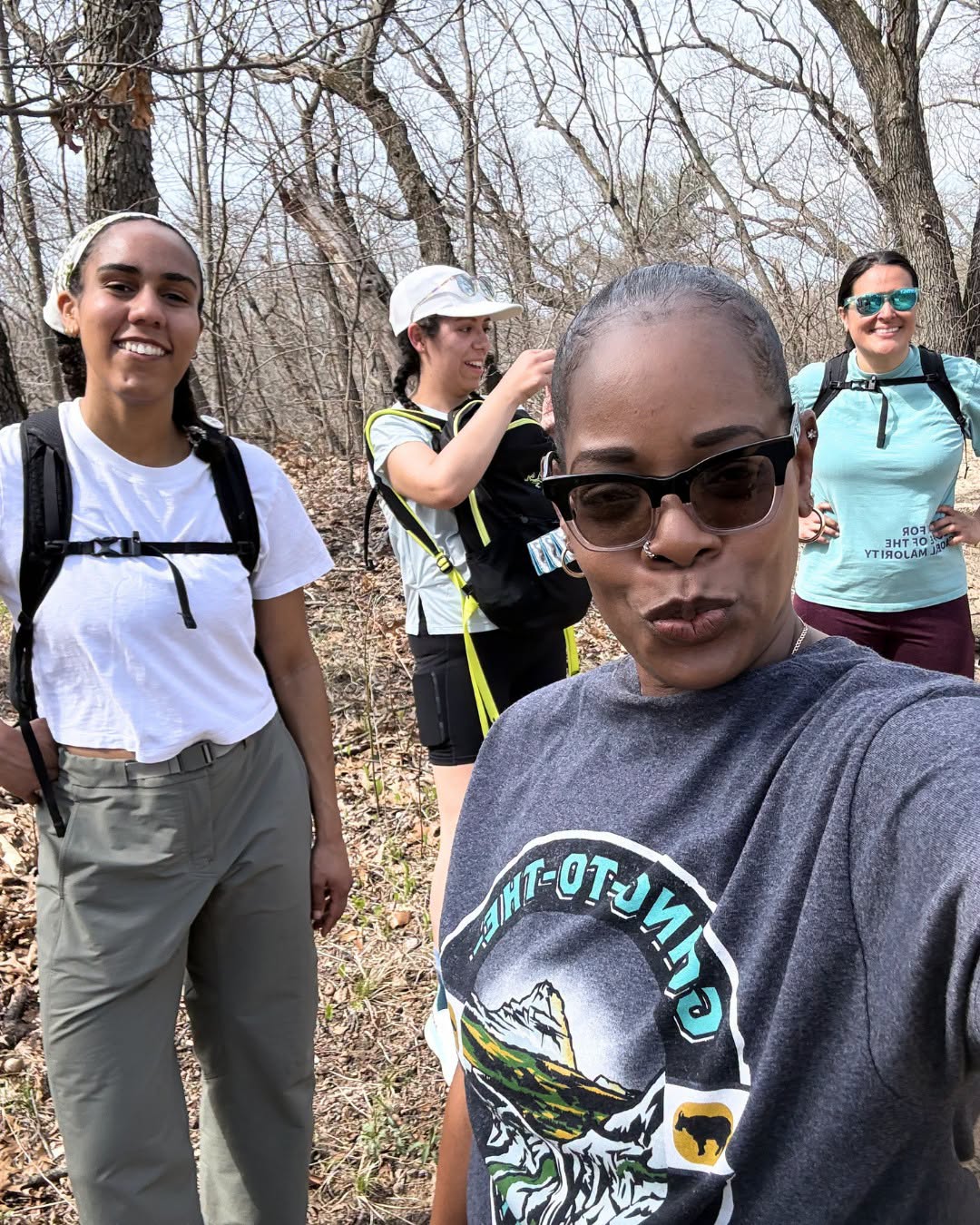
By the time our communities gathered at Indiana Dunes State Park outside Chicago, something special had already taken root, now joined by even more new Midwest participants who arrived ready to connect.
Newcomers were welcomed like old friends. Meals were shared. Gear was exchanged. Community members came together to offer their knowledge of the dunes while around the bonfire, stories, laughter, and quiet moments of rest filled the evening air.
Then came Sheila, an injured blue bird found by participants that became an unexpected companion for the weekend! Community members cared for her until wildlife professionals arrived, embodying the stewardship and compassion that live at the heart of both organizations.
Outdoor Afro leader Sheena Duffey reflected on the experience beautifully:
“There’s something special about being surrounded by nature and even better when it’s shared with community. These are the kind of memories that stay with you—rooted in connection, culture, and the joy of the outdoors.”
And that’s exactly what these campouts created: memories rooted deeply enough to travel home with us.
One Journey, Many Campfires
Across every campsite, one truth remained constant: our communities belong in the outdoors, not just as visitors, but as outdoor leaders, storytellers, and caretakers. We are joyful participants in the natural world. This collaboration between Outdoor Afro and Latino Outdoors demonstrated what becomes possible when Black and Latino communities gather with intention.
The campfires may have gone out for now, but the relationships, confidence, and memories created on this journey continue to glow. And this story is still being written with additional campouts planned for later this summer, we look forward to welcoming even more people into experiences that nurture wellness, deepen connection, and build lasting community in the outdoors.
So whether you’re a seasoned nature enthusiast or finally inspired to embark on your very first outdoor adventure, there’s a place for you with us on future trips!
To connect with nature and find upcoming events near you, download the Outdoor Afro app and visit Latino Outdoors’ blog.
We can’t wait to see you on the trail, around the campfire, and in community.
Free to Be the Best Me: A Juneteenth Reflection on Outdoor Wellness
Free to Be the Best Me
A Juneteenth Reflection on Outdoor Wellness
Freedom anniversaries ask us to look both backward and forward. On June 19th, 1865, two and a half years after the Emancipation Proclamation, news of liberation finally reached Galveston Bay, Texas. That day, our ancestors stepped into a new reality that was equal parts possibility and uncertainty. Ever since, Black communities have marked Juneteenth with music, food, dance, and celebration.
We’re adding another layer to that tradition: we celebrate by moving our bodies through sunlight, fresh air, and wide open landscapes.
Making Waves: Freedom Flourishes in Community
Juneteenth reminds us that progress has always been powered by people working together. Today, expanding access to water safety and swim education requires that same spirit of collective action.
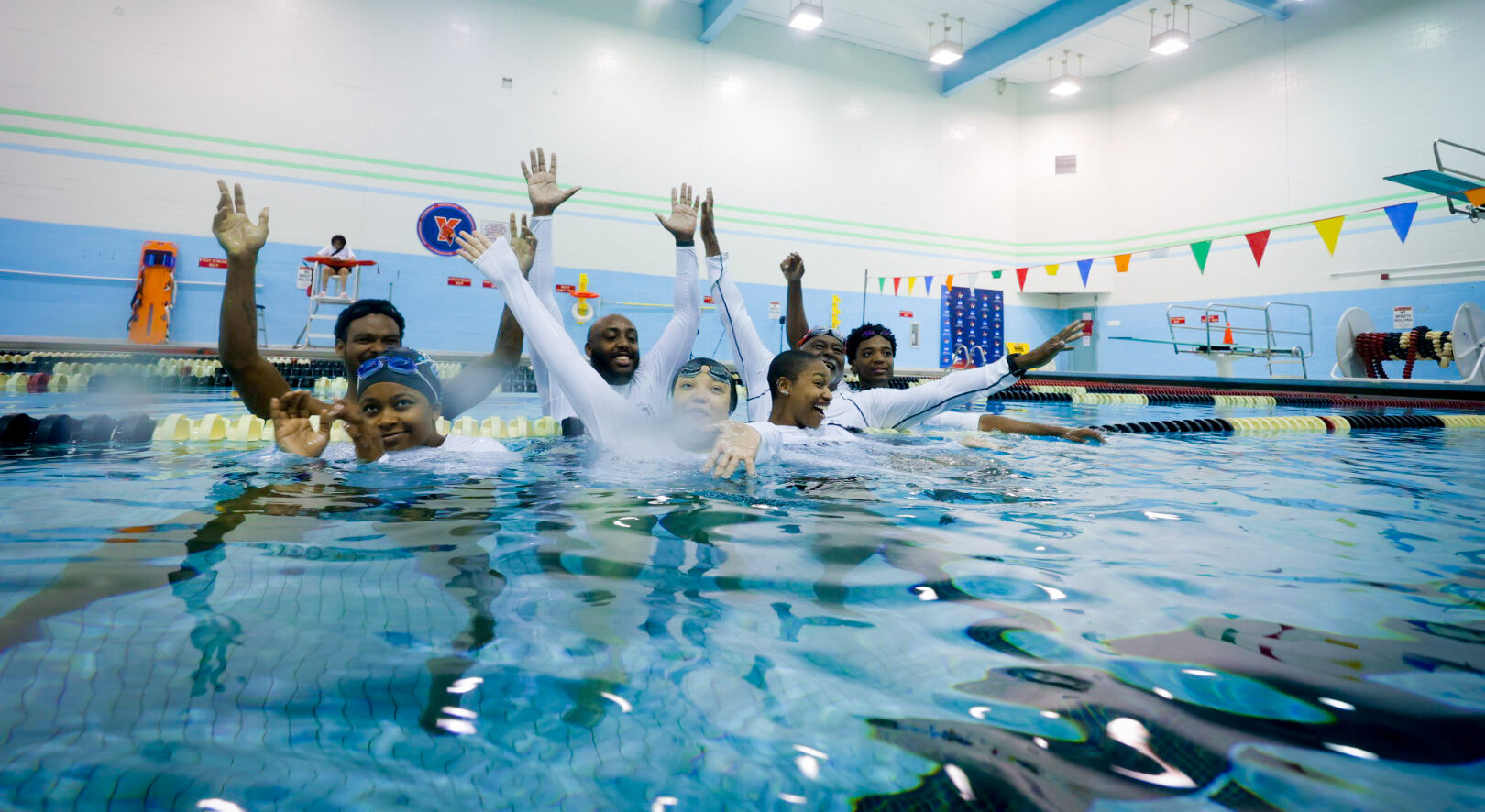
Making Waves is building a network of Community Collaborators who share our commitment to ensuring that Black children, families, and communities have access to life-saving swim education. Through these partnerships, we can create pathways to confidence, safety, joy, and belonging in and around water.
We’re not talking about one day clinics. Our goal is to connect families with a full beginner swim series that builds skills over time and empowers participants to reclaim freedom in the water.
Do you know a swim school, instructor, community organization, recreation center, or aquatic program that shares this vision? We’d love an introduction. Use the link below to refer to an organization.
If your organization is interested in joining the network, visit the Outdoor Afro app and submit a Swim Partner Application.
Why the Outdoors Matter
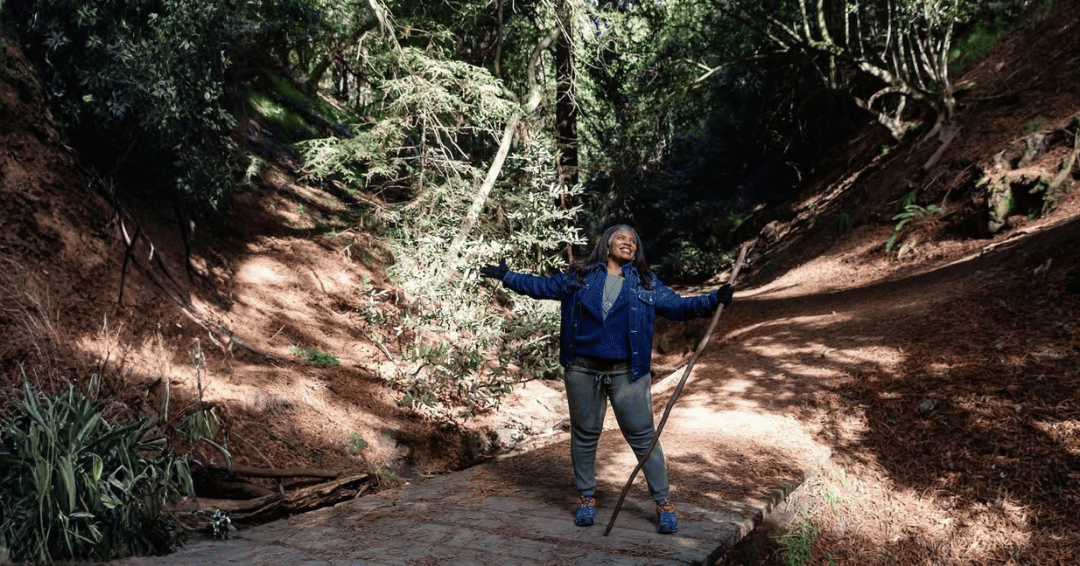
Outdoor Afro’s mission of reconnecting Black people with natural spaces springs from lived history. There was a time when forests hid patrolmen, lakeshore parks posted whites-only signs, and hiking gear ads erased faces that looked like ours. Yet our elders found ways to garden, fish, explore and thrive in nature all the same. Today, when we kayak rivers or learn to fish in our communities, we honor their ingenuity and announce, “We belong here.”
That belonging is also supported by decades of research confirming what intuition already knew. There are over 1000 studies on nature’s impact on wellness.
For Outdoor Afro, this matters because many of the wellness challenges facing our communities are connected to chronic illnesses like hypertension, heart disease, and diabetes that disproportionately affect the Black people. Time outdoors is one practical way to support prevention, movement, stress reduction, and overall wellbeing.
Research on green space points in a similar direction. A 2024 systematic review and meta analysis found that greater access to green space was associated with lower odds of diabetes and hypertension. [1] Another large review found that nature exposure is linked with positive outcomes including improved blood pressure, physical activity, mental wellness, sleep, and cognitive function. [2]
The takeaway is simple: being outdoors supports wellness in many ways that don’t have to be complicated. A walk through the neighborhood, time near water, a bike ride, or a community hike can all become part of how we care for our bodies, steady our spirits, and practice freedom in real time.
Simple Ways to Thrive Outdoors
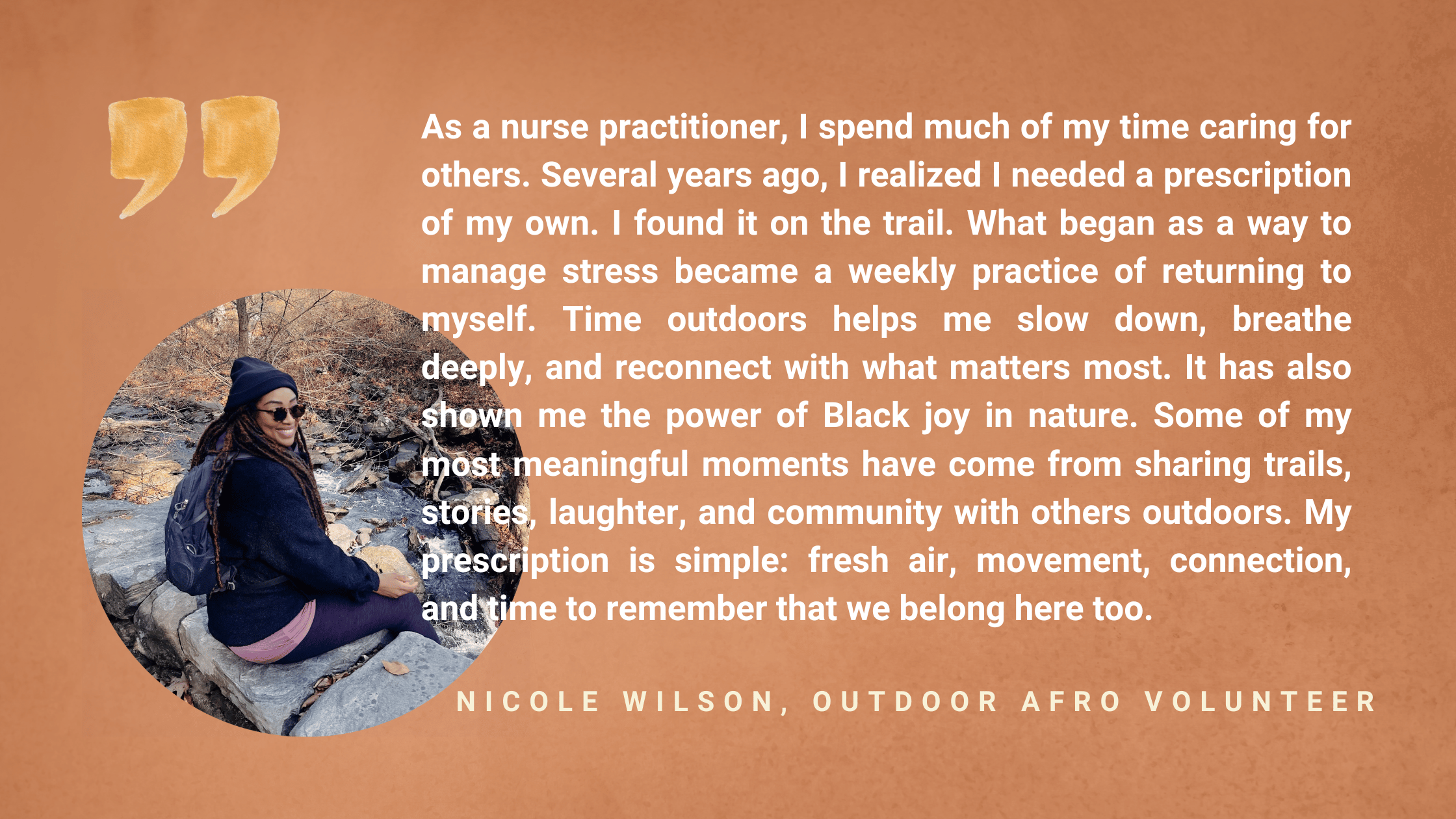
Nowadays, our community seems to be busier than ever, but you can embrace wellbeing through simple daily choices. We turned to Nicole Wilson, an Outdoor Afro Volunteer, to share her expertise by asking what is your NatureRx* and how does it help you feel free, grounded, and well in your body, spirit, and relationship with nature? *NatureRx is your personal prescription for wellness through nature. It can be an outdoor activity, place, or practice that supports your physical, mental, emotional, or spiritual wellbeing.
So let’s enjoy the fresh air as we elevate Juneteenth to more than a date on the calendar and into a season of embodied freedom that lasts all year. Download our app to explore upcoming events. See you on the trail where we are free to be well and free to become our best selves every step of the way.
Sources:
[1] A 2024 systematic review and meta-analysis found that green space access was associated with reduced odds of diabetes mellitus, hypertension, and obesity. https://pmc.ncbi.nlm.nih.gov/articles/PMC10953288 “Association of greenspaces exposure with cardiometabolic …”
[2] A 2021 review in the International Journal of Environmental Research and Public Health found evidence linking nature exposure with improved cognitive function, brain activity, blood pressure, mental health, physical activity, and sleep. https://pmc.ncbi.nlm.nih.gov/articles/PMC8125471 “Associations between Nature Exposure and Health – PMC – NIH”
Mother's Day, Mother Earth
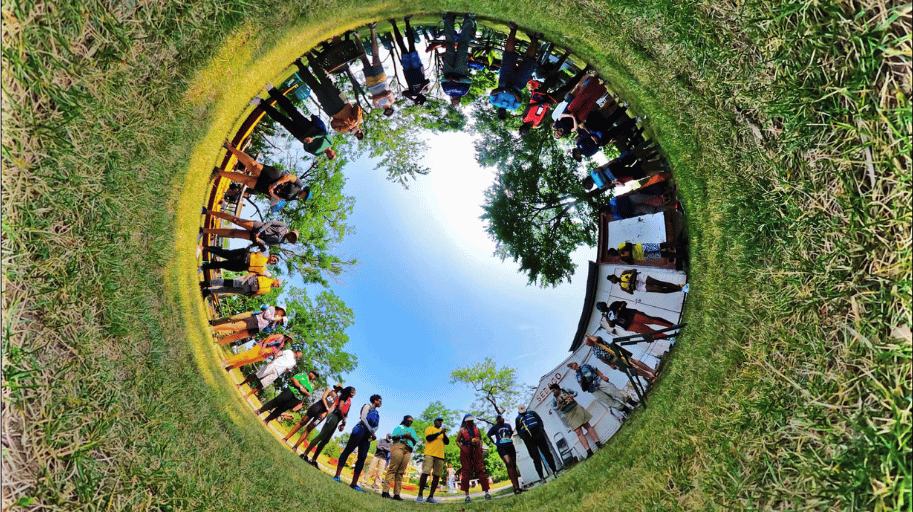
Mother’s Day is a reminder to look up, step out, and remember: care is lived in the everyday. It shows up in how we move through the world, how we tend to what’s around us, and how we stay connected to what sustains us. And in the way Outdoor Afro understands “home,” care has always been simple: we believe the strongest kind of stewardship begins with love.
Because when you fall in love with nature, you naturally want to protect it.
That’s the heartbeat of our work.
Outdoor Afro celebrates and inspires Black connections and leadership in nature. We reconnect Black people to our lands, water, and wildlife through outdoor education, recreation, and conservation. And in all the hiking, biking, fishing, kayaking, gardening, skiing, and everything in between, there’s a deeper intention: our programs are designed to help people build real relationships with local ecosystems, close to home, rooted in community, and strong enough to last.
Love changes how you move through the world.
When a child learns the name of a plant, that plant becomes familiar. It becomes something to notice, to learn from, to care about.
When you spend time by the same creek across seasons, you begin to notice what shifts. You notice what belongs there and what doesn’t. You begin to understand it in a personal way.
When you find a trail that makes you feel peaceful, you want it to stay safe and beautiful. You want your niece to walk it one day. You want your elders to have a place where they can breathe. You want your people to keep gathering there with ease.
That’s stewardship. It begins with belonging.
One of the most powerful things Outdoor Afro does is create space for that belonging to grow. We invite people into nature in ways that feel welcoming and grounded. We help people touch it, learn it, laugh inside it. We make it feel approachable, especially for those who were taught (directly or indirectly) that the outdoors wasn’t meant for them.
The truth is, connection to land and water has always been present: in bodies, in histories, in the ways communities have always gathered, rested, played, and survived in relationship with the land.
Mother’s Day is a moment to acknowledge care as something practiced and shared, including care for the natural world.
The more people return to nature, the more care grows.
That care shows up in quiet ways that matter. It looks like treating a park like part of the neighborhood. It looks like noticing wildlife with respect. It looks like picking up a stray piece of trash. It looks like teaching children that the outdoors is something they are in relationship with.
It also looks like leadership. The kind Outdoor Afro has always stood for. The kind rooted in care and community, where people support one another in shaping the culture of outdoor life.
So on Mother’s Day, there’s an invitation to begin where you already are.
Fall in love with your local ecosystem on purpose.
Choose one place near you: a park, a trail, a shoreline, a community garden, even a stretch of sidewalk where trees grow. Visit it again and again. Watch it change. Learn one new thing each time. Bring someone you love. Let it become meaningful through attention and care.
That’s how stewardship grows. Through practice.
If you want to plug into Outdoor Afro this season, we’re here. Our year round activities are designed to make it easier to get outside with support, encouragement, and community, so relationships with nature can deepen naturally. Whether someone is brand new or has spent a lifetime outdoors, there is space for them in this family.
Mother’s Day is one moment in a continuing practice of care. The kind that ripples forward.
Because time spent with land and water shapes how people move through the world. It strengthens attention. It deepens responsibility. It builds a sense of connection to what will come next.
That is the future being built together.
So download the app and join us for a little fresh air!
6 Steps to Fundraising $1,000+ in 5 Days (A Guide From Real People Who Actually Did)
6 Steps 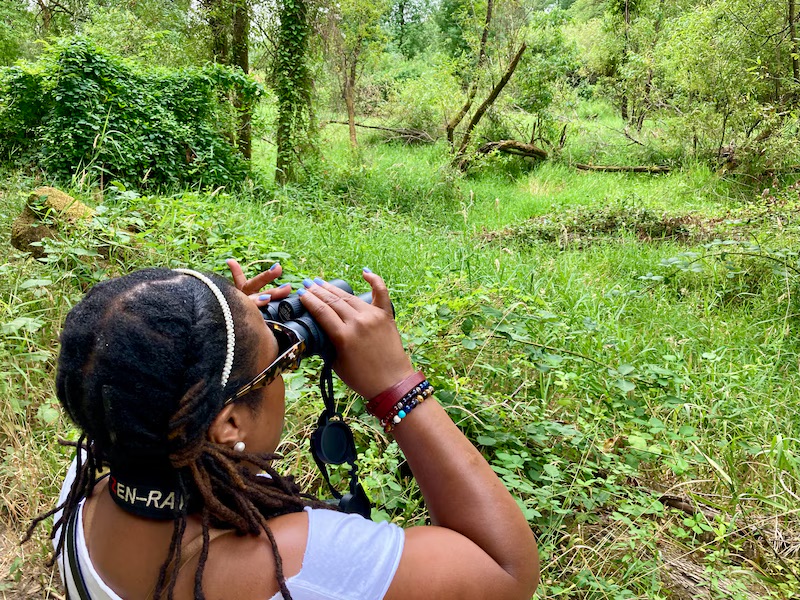 to Fundraising $1,000+
  in 5 Days
  (A Guide From Real People Who Actually Did)
If you’ve ever wondered how people actually raise serious money in a short amount of time… this is your guide.
Real people. Real strategies. Real results.
Let’s walk through six steps that can help you raise $$$ quickly, featuring Tennema (who raised over $1K) and Lydia (who raised over $2K in just 5 days).
1. Start Close; Your People Are Your Power
Before going wide, go deep.
Tennema started with the people who already know and love her:
“To get donations to my fundraiser, I started off by sharing the landing page in family/friend group chats. I included a brief message on why the fundraiser was important to me and shared that I would be very grateful for any contributions made towards it.”
This works because:
- You’re not cold-pitching
- You’re inviting people into something meaningful
- People are more likely to give when there’s a personal connection
2. Make It Easy to Share (multiply your reach)
Don’t just ask for donations… ask people to spread the word. Tennema shared,
“I also encouraged my family to share the fundraiser within their own networks, which really helped cast a larger net.”
This is where things start to grow beyond your immediate circle.
Think of it like:
- You → your people
- Your people → their people
That’s how momentum builds.
3. Use Social Media (but don’t rely on it alone)
Social media helps, but it’s not the whole strategy.
Here’s how Tennema got strong results:
“My biggest influx of donations came when I shared the fundraiser on my personal social media platforms. I shared my goal and how close I was to meeting it, which I think made it feel attainable and didn’t pressure anyone to give a single large donation, but rather more smaller ones.”
Meanwhile, Lydia noticed something important:
“My initial posts had a minor impact: I posted on Facebook and LinkedIn, but these generated very limited traction—only one $25 donation on Facebook. This reinforced that passive posting alone wasn’t enough.”
Takeaway:
Post (but don’t stop there).
4. Make Direct, Personal Asks (this is where the money comes from)
This is the step most people skip, and it’s the most powerful.
Lydia’s biggest success came from email:
“Direct email outreach had a major impact! I sent a message to my holiday card/email list (about 90 people), which resulted in about $1,250 raised. I offered a personal match of the first donation that came through. This was the most effective single action—people who already had a personal connection to me were most responsive.”
And Tennema reinforced the same idea:
“I also sent a few individual messages to folks who wouldn’t have caught my messages in group chats/social platforms.”
Yes, it can feel uncomfortable:
“It was a bit scary initially making the ask, but because it’s for a great cause, there were many people willing to contribute.”
But this is where real results happen.
5. Tell a Story (video = even better)
People don’t just give to links. They give to meaning.
Lydia leaned into storytelling:
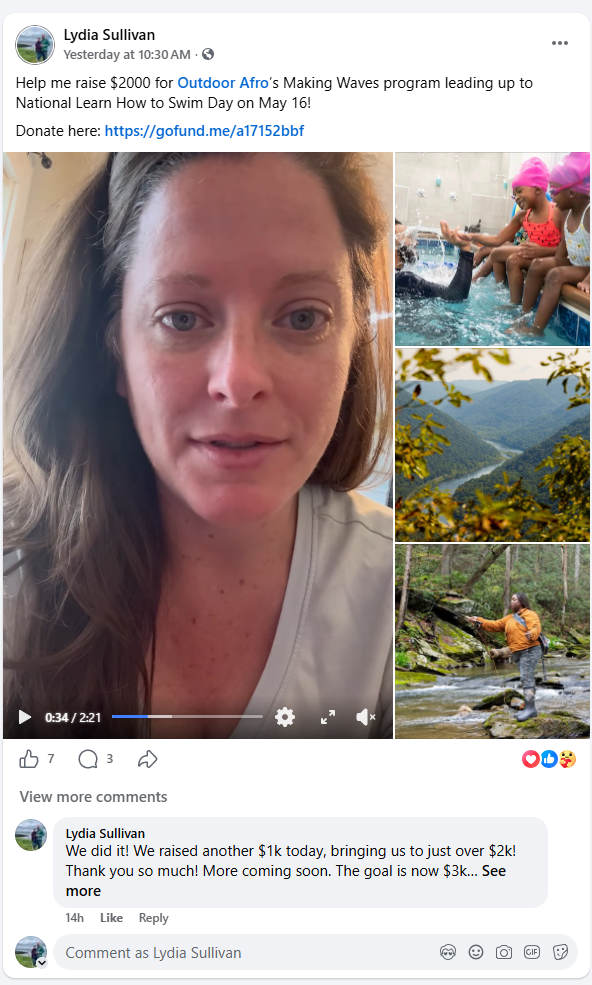
“Video storytelling = moderate impact. I recorded and shared a personal video explaining why Making Waves matters to me, paired with Outdoor Afro imagery. Posting this on Instagram and Facebook along with photos provided by Outdoor Afro helped raise another $750. At the end of the day, I posted another video thanking everyone for their response and gifts.”
Storytelling helps people:
- Understand why it matters
- Feel connected
- See the impact
6. Follow Up + Show Gratitude (this builds momentum)
This is where good fundraisers become great ones.
Lydia stayed engaged throughout:
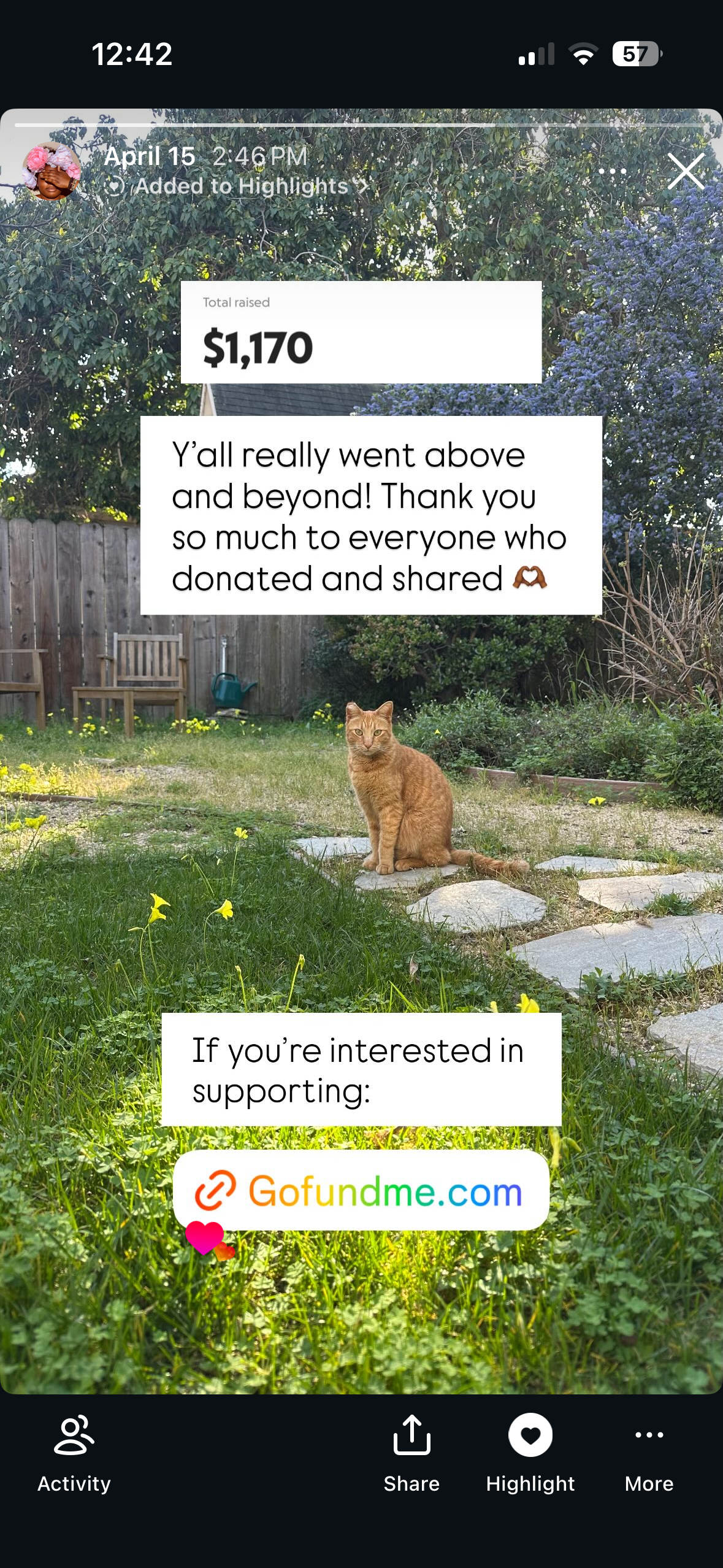
“I sent individual thank-you texts and emails as donations came in. This helped deepen relationships and encouraged continued sharing. I also got to hear from my friends and family why they also love Making Waves! Bonus: Posting a thank you message after my social media sprint resulted in $200 more in donations.”
And she didn’t stop there:
“I’m continuing with weekly follow-ups across LinkedIn, Facebook, Instagram, and email. I’m also removing people who have already donated to avoid over-messaging and keep outreach thoughtful.”
Her biggest lessons say it all:
“1. Personal asks outperform general posts; emails still work! 2. Video storytelling significantly increases engagement and giving 3. Consistent follow-up is essential 4. Gratitude builds momentum and community”
Raising money isn’t about having a huge audience.
It’s about:
starting with your people being clear about why it matters showing up consistently and inviting others into something meaningful Tennema raised over $1K.
Lydia raised over $2K in just 5 days.
Not because they had perfect strategies.
Because they showed up, asked, and stayed connected.
And you can too.
Lydia raised over $2K in just 5 days.
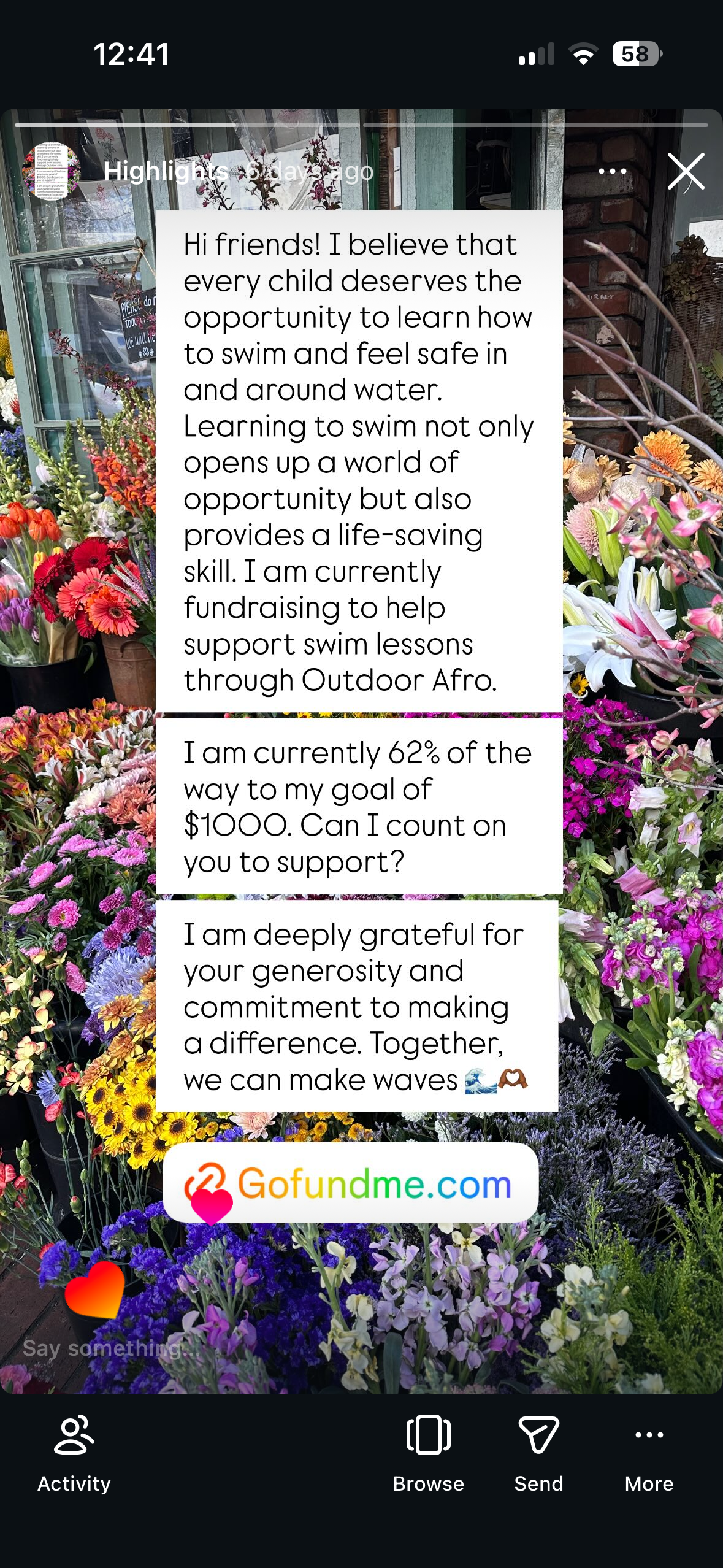
SOCIAL POST EXAMPLES
See Real Posts That Worked
Still unsure what to say? Add some personalized touches to this template then copy and paste!
Hey y’all! I’m raising funds for Outdoor Afro.
This organization is all about helping Black people connect with nature, build community, and create meaningful experiences outdoors.
If you’re able to support or share, I’d really appreciate it. I’ve linked my page below.
Thank you for being part of this with me!
Celebrating Our Outgoing Board Members: Melanie Strong & Michael Brune
At Outdoor Afro, our story has always been shaped by people who believe deeply in the power of connection to land, to community, and to ourselves. Two of those people, Melanie Strong and Michael Brune, have helped guide that story in profound ways.
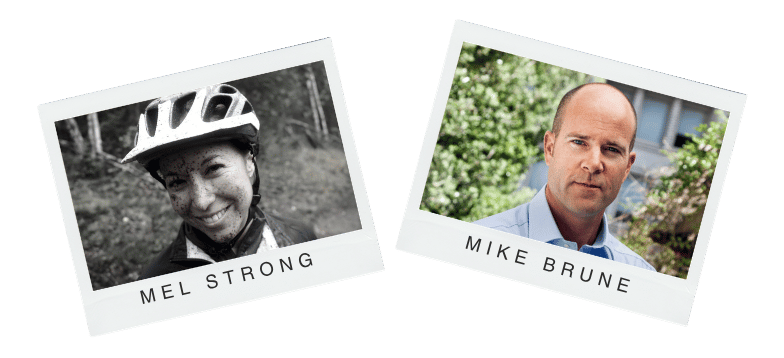
As their board service came to a close at the end of 2025, Mike after eight years and Mel after six, we find ourselves not just reflecting on their leadership, but feeling the lasting imprint of their presence across the movement.
Their time with Outdoor Afro was about more than governance or guidance. It was about belief. Belief in a vision that Black joy belongs in nature, that leadership can be cultivated outdoors, and that when people are given space to connect, something powerful unfolds.
One of the most vivid reflections of that impact comes from Mel Strong, who recalls a moment that brought the mission into full clarity:
“The moment that best captured the power and possibility of our mission came when I was at a Ramble Campground last year and met Black families and first-time campers laughing together around a campfire and saying, ‘This space is for me too.’ That feeling of ease and joy in nature is exactly what Rue set out to create. Watching it come to life made the mission very tangible for me.”
It’s a simple image, families around a campfire, but it holds something expansive. A sense of belonging. A quiet shift in what feels possible.
Mel has seen that shift happening across the country, as more Black hikers, campers, and cyclists step into outdoor spaces not just as visitors, but as participants in a growing culture of connection and joy.
“I’m proud to have been part of building something that helps create real opportunities for Black joy in nature.”
For Mike Brune, that sense of possibility stretches back to the earliest days of Outdoor Afro.
He first met Rue Mapp while serving as Executive Director of the Sierra Club, shortly after she founded the organization. Even then, something about her vision stood out. “I was inspired by her vision and deeply impressed with her positivity, charisma, and clear strategy for how to grow the organization,” he shares.
Both Mel and Mike describe their time with Outdoor Afro as transformative thanks in part to what they helped build, and in how they themselves were changed.
For Mel, the experience deepened her personal relationship with nature in a way that went beyond recreation.
“Being part of Outdoor Afro’s board deepened my relationship with nature in a very personal way. I’ve always loved the outdoors, but this experience helped me see it not just as a place for adventure or escape, but as essential to my own mental health and sense of wholeness. It reminded me that nature is medicine, and that time outside is foundational.”
Her time on the board also expanded her understanding of the historical relationship between Black communities and the outdoors: one rooted not in absence, but in legacy.
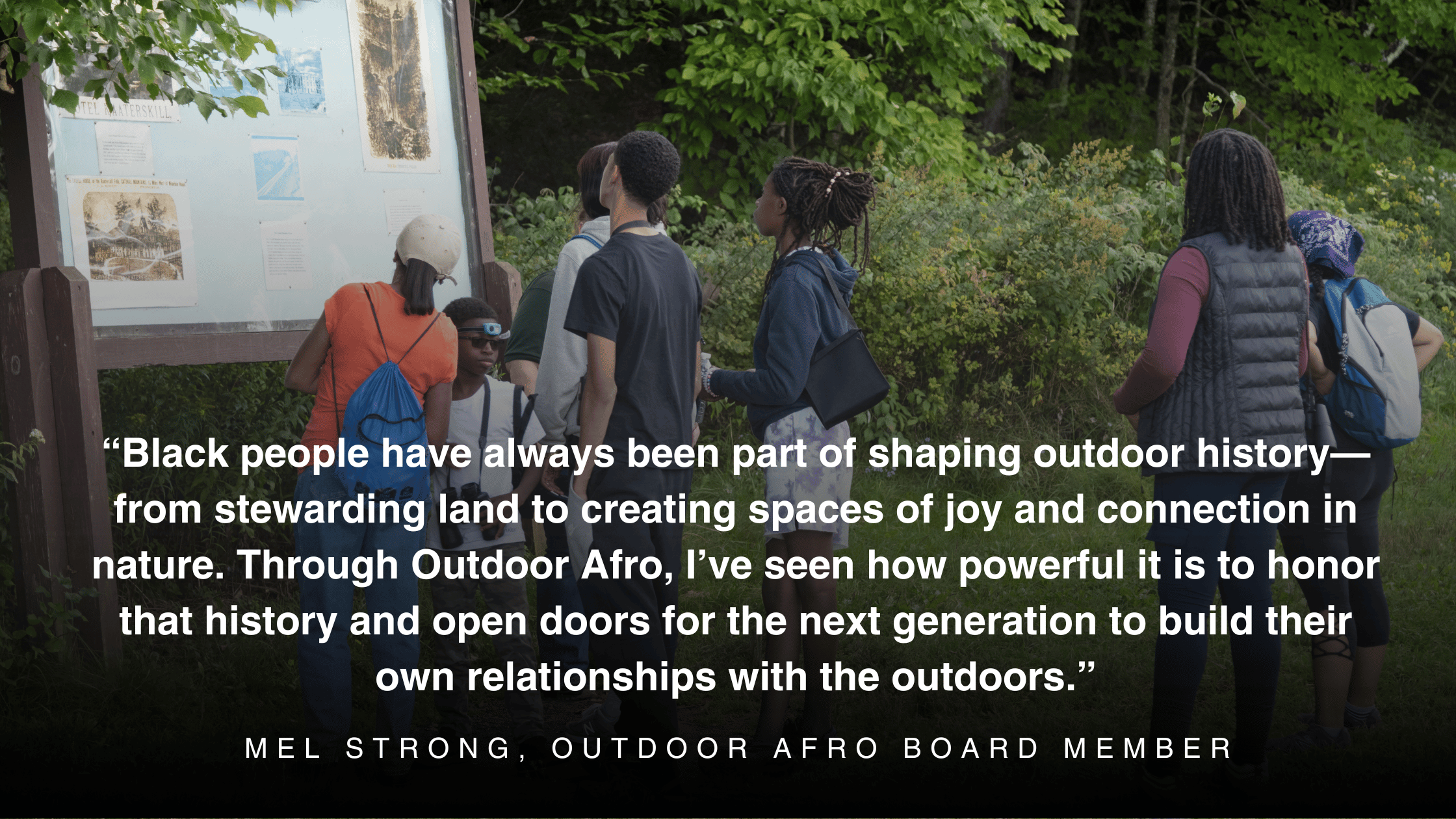
Mike reflects on the people who make up the Outdoor Afro community, leaders from across industries and backgrounds, all drawn together by a shared commitment to something larger than themselves.
“We have nonprofit leaders and venture investors, outdoor industry executives, tech leaders, accountants, lawyers, doctors, and longtime volunteers,” he shares. “We all carve out time in our busy lives to get outside for reflection, inspiration, solace, and adventure.”
Through that collective commitment, he’s witnessed both the barriers people face and the beauty that emerges when those barriers are removed.
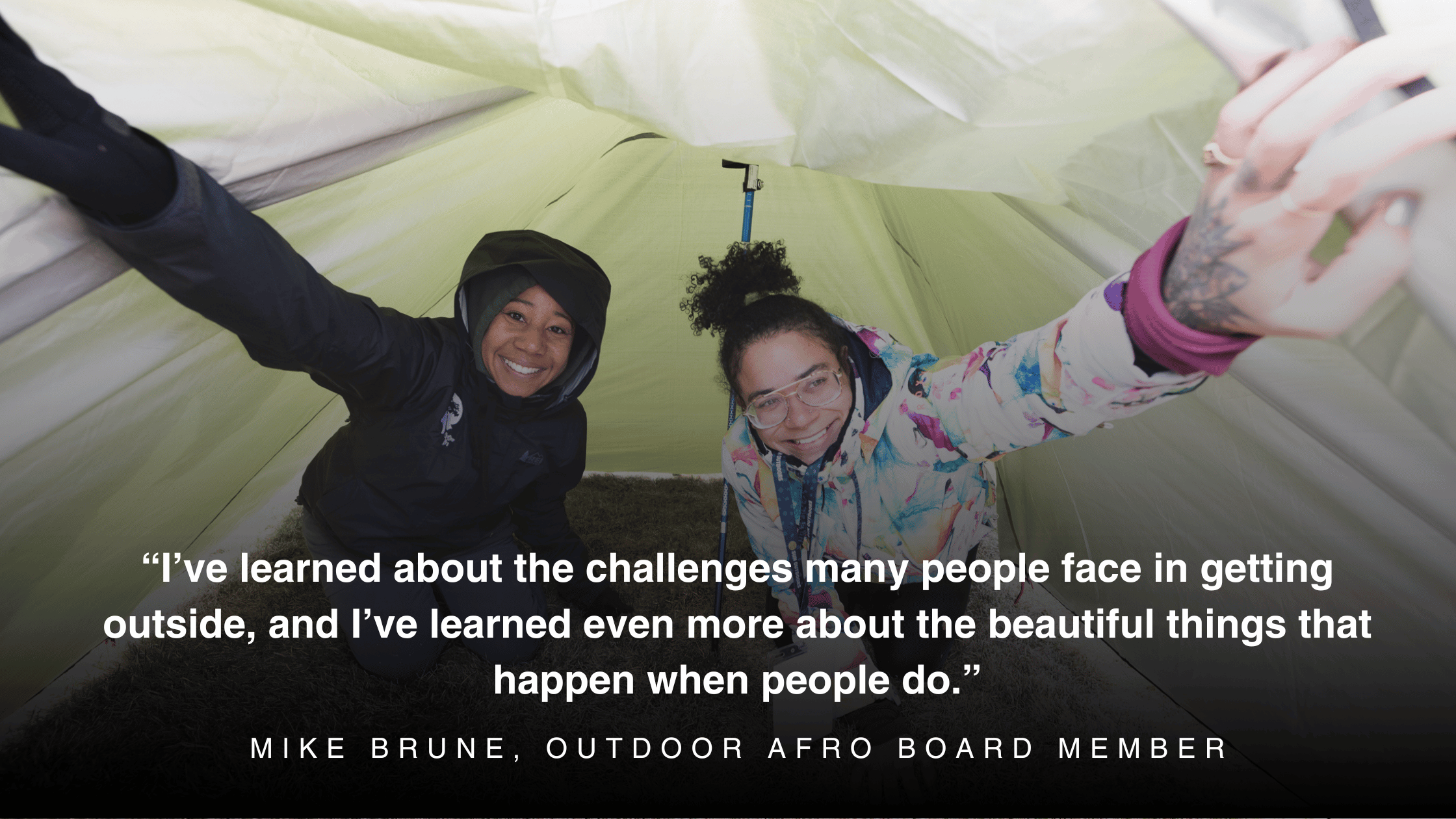
Looking ahead, both Mel and Mike speak with a sense of hope for growth and for deepened impact.
Mel envisions a future where connection to nature is simply part of everyday life: "Black joy in nature is simply part of everyday life, where kids grow up seeing themselves reflected in outdoor spaces, and where communities continue to shape outdoor culture.” She sees Outdoor Afro evolving in ways that go beyond access, into long-term pathways for wellness, leadership, and generational connection, noting, “The next chapter isn’t just about getting more people outside. It’s about creating lasting pathways for wellness, leadership, and connection to the land so our kids and grandkids inherit a stronger relationship with nature.”
Mike, when asked what inspires him most about the future, offers a simple but powerful answer: “The people,” he says. “What a beautiful thing to be a part of. I’m grateful to Rue for her hard work and determination, and to the quietly inspiring board members and other volunteers who have brought her vision to life.”
As we celebrate Mike and Mel’s service, what stands out most is not just what they’ve done, but what they’ve helped make possible.
More connection.
More leadership.
More joy.
We are deeply grateful for their partnership, their vision, and the legacy they leave behind—one that continues to grow every time someone steps outside and feels, maybe for the first time:
This space is for me too.

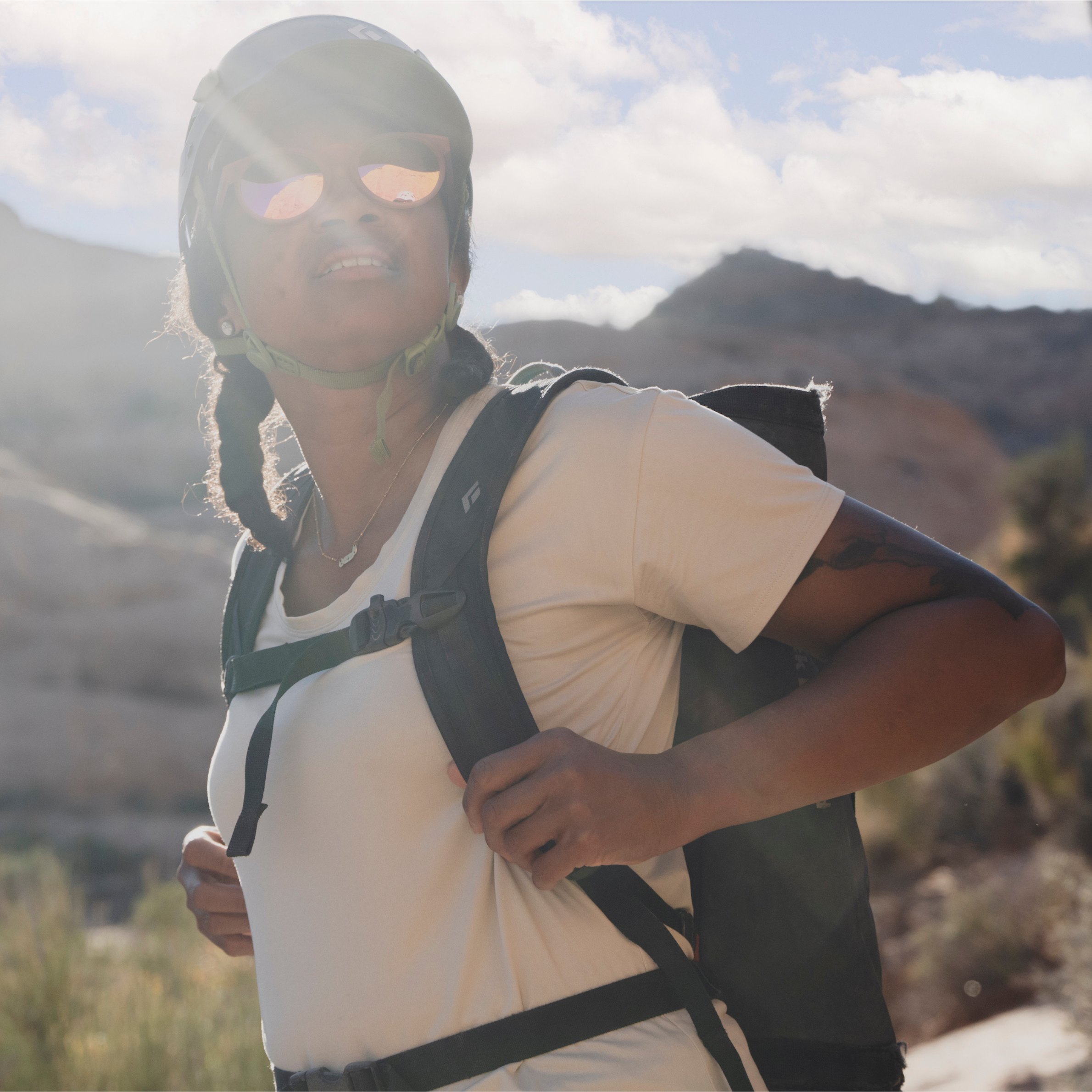
Beginner-Friendly Guides to Hiking and Camping: Your Path to Outdoor Adventures
If you’re new to hiking and camping, you’re in the right place! At Outdoor Afro, Inc., we believe that everyone should feel empowered to enjoy the beauty and benefits of hiking and camping, whether you’re a beginner or advanced. We’ve curated a beginner-friendly guide to give you the confidence and tools you need to hit the trails, and set up camp with ease.
Exploring the outdoors doesn’t have to be complicated or intimidating. With the right preparation, mindset, and gear, your first adventures can be safe, enjoyable, and deeply rewarding. So, grab your backpack, lace up those boots, and let’s dive into the basics of hiking and camping!
Why Hiking and Camping Are the Perfect Activities for Beginners
If you’ve ever felt the pull of nature but weren’t sure where to start, hiking and camping are ideal beginner-friendly activities. They allow you to immerse yourself in natural beauty, disconnect from the hustle of everyday life, and reconnect with yourself and your surroundings.
Both activities are scalable to your comfort level. You can start with short hikes on easy trails and gradually work your way up to overnight camping trips. Plus, these outdoor experiences offer incredible health benefits for physical, mental, and emotional wellbeing.
Outdoor Afro Inc.’s Top Tips for New Hikers and Campers
To help you get started, we’ve compiled some of the best tips for beginners, ensuring that your first experiences are both fun and memorable.
1. Start Small and Build Confidence
When beginning your outdoor journey, ease into it by selecting shorter hikes or car camping trips. Look for local parks with well-maintained trails that are rated as “easy.” These shorter adventures will help you get a feel for being in nature while building your confidence.
2. Wear the Right Gear for Comfort and Safety
Having the right gear can make all the difference when you're hiking or camping. For hiking, opt for sturdy, comfortable shoes with good traction. Trail shoes or hiking boots are perfect. Layer your clothing so that you can easily adjust as temperatures change. For camping, a reliable tent and a warm sleeping bag are essential to a good night’s rest.
Pro Tip: Don’t overpack. Stick to the basics: water, snacks, layers, and sun protection are your best friends for a day hike. For camping, start with car camping so you don’t have to carry your gear too far.
3. Stay Hydrated and Fueled
Whether hiking or camping, staying hydrated is crucial. Always carry enough water for your hike or have a reliable source at your campsite. For day hikes, pack lightweight snacks like nuts, fruit, or energy bars to keep your energy up. For camping, consider meals that are easy to eat outdoors, like sandwiches or sliced veggies.
4. Choose Beginner-Friendly Trails and Campsites
Selecting the right location is key to having a positive experience. For hiking, look for well marked trails that are rated as beginner-friendly with minimal elevation gain. For camping, car campsites are perfect for newbies because they offer amenities like bathrooms, picnic tables, and fire pits, making the experience easier and more enjoyable.
5. Learn Basic Navigation Skills
While it’s easy to follow well marked trails, having basic navigation skills is a good idea, especially if you’re hiking in more remote areas. Learn how to read trail maps, carry a compass, and download a GPS app on your phone. For camping, familiarize yourself with campsite maps and locations of nearby amenities.
6. Embrace the ‘Leave No Trace’ Principles
Part of being an outdoor enthusiast is respecting nature. The Leave No Trace principles are essential for anyone venturing into the wild. These guidelines help ensure we minimize our impact on the environment by packing out all trash, staying on designated trails, and leaving natural objects (like rocks or plants) undisturbed.
7. Practice Setting Up Your Tent
If you’re new to camping, practicing setting up your tent at home can save you a lot of hassle when you arrive at your campsite. Ensure you know how to pitch your tent and secure it properly with stakes. This practice will give you peace of mind, especially if you’re faced with setting up camp in the evening or in less than ideal weather.
8. Bring a Friend for Fun and Safety
Outdoor adventures are even better when shared. Bring along a friend, family member, or join a group hike to make the experience more enjoyable and safe. Not only will you have someone to share the excitement with, but it’s also reassuring to have a companion on the trail or at the campsite.
Start Your Outdoor Journey with Confidence
Whether you're a seasoned explorer or just starting your outdoor journey, hiking and camping offer incredible experiences that foster a deeper connection with nature and yourself. With the right mindset, gear, and preparation, anyone can enjoy the great outdoors.
At Outdoor Afro Inc., we’re here to guide and support you every step of the way. So, get out there, explore, and remember: nature is for everyone!
Ready to take your first steps into the wild? Share your experiences with us on social media using #OutdoorAfro and #blackjoy, and be sure to follow our community for more beginner tips and inspiration.

From Ripples to Waves: How Your Support Helped 3,200 New Swimmers in 2025
From Ripples to Waves: How Your Support Helped 3,200 New Swimmers — and Why This Work Matters More Than Ever
Across the country this year, something powerful happened in pools, swim schools, and community centers. Because of people like you, more than 3,200 Black children, parents, grandparents, and caregivers were able to learn lifesaving beginner swim skills through Outdoor Afro’s Making Waves program.
Each of those 3,200 swimmers carries a story — a before and after. A moment of hesitation turning into a smile. A bit of fear turning into a breath of courage. A first float. A first kick.
This isn’t accidental, it’s the result of a clear mission: helping Black families not only learn to swim, but reclaim and strengthen their relationship with water — a relationship that has been historically disrupted.
Why Making Waves Exists
Swimming isn't just a life-saving skill, it's a nature-connecting one. Yet the racial disparities in access and safety are stark.
According to the CDC, Black youth ages 10 to 14 drown in swimming pools at more than 8 times the rate of their white peers. This isn’t due to a lack of interest — but a legacy of exclusion from public pools, beaches, and waterfronts.
Outdoor Afro launched Making Waves in 2019 to address this public health crisis by removing a key barrier: cost.
Our mission is simple: Help every Black child and caregiver within our reach learn how to swim — safely, confidently, and joyfully.
The Making Waves program covers the cost of beginner swim lessons for children, adults, and families nationwide. Families choose the instructor or the facility that works best for them, we handle the reimbursement, they handle the joy.
This year’s challenge was our largest yet — and you helped us meet it.
We set out to fund 2,000 new swimmers in 2025. We not only met our goal, we exceeded it, funding more than 3,200 new swimmers before year's end.
Meet the Swimmers You Supported
Below are just a few of the many stories shared with us this year. Each represents a family who gained safety, confidence, and connection because someone like you chose to invest in their experience.
Laila, 5 — “We realized she was meant to swim.”
For Laila and her mom Krystal, swim lessons opened a door to something unexpected:
“I’m so glad that we received a scholarship to put my daughter Laila (5yrs) in swimming. It was her first time, but soon enough, we realized that she was meant to swim! She is a natural in the water, and just seeing her blossom from this experience has been great.”
What started as a first lesson has become a passion:
“Even now, since the scholarship has ended, she still goes to swimming lessons and has promoted throughout her swim levels. She can now float unassisted, glide through the water, and is working on her backstroke.”
Thanks to the Making Waves program, Laila discovered something she truly loves and developed a skill that will stay with her for life.
Sabrina’s 3-Year-Old — “She wholeheartedly enjoyed it!”
In Minnesota, Sabrina wanted her daughter’s introduction to water to feel safe and joyful:
“I have nothing but great things to say about Outdoor Afro! They made it possible for my 3yr old to have swimming lessons, which she wholeheartedly enjoyed! Water safety is very important to me along with enjoying the water! Thank you again!
This is what it looks like when access and joy meet early. A strong start at age three can shift the trajectory of an entire family’s relationship with water.
Carolyn, 59, & Her Four Grandchildren — “After all of these years, I finally fulfilled my lifelong dream.”
Perhaps one of the most moving stories this year came from Carolyn, who decided it wasn’t too late to learn:
“After all of these years, at age 59, I finally fulfilled my lifelong dream of learning to swim.”
She didn’t stop there. She enrolled four grandchildren, ages 10, 5, and 4-year-old twins:
“The 10 year old was so fearful of the water, but after 3 sessions this summer he swims like a fish. The 5 year old is improving as a beginner and the twins ‘had fun.’ We will all take lessons again next summer so we can be safe and enjoy the water.”
This wasn’t just one person learning to swim. It was five. Five new stories, five safer swimmers, five deeper connections to water and to each other.
Family transformation — that’s the impact you helped create.
More Stories, More Joy, More Safety — All Made Possible by You
These three stories are only a glimpse into the families who wrote to us this year:
Parents like Marquita, who said swimming lessons helped her overcome a lifetime of anxiety around water.
"Thankfully I found Outdoor Afro and their swimming reimbursement program. This allowed me and my daughter to take lessons and me to overcome my anxiety. I feel more comfortable swimming and have even started going to local indoor pools regularly for fun and exercise."
Adults like Aja, who shared:
“I’ve always been a lover of water and adventure — but my fear of drowning and inability to swim held me back. This scholarship from Outdoor Afro gave me the opportunity to conquer that fear and experience more of life how I’ve always wanted. Not only am I learning to swim myself, but I’m gaining skills transferable to those around me. I am beyond grateful for this scholarship and the initiative Outdoor Afro has taken to empower people."
Teens, toddlers, parents and grandparents who discovered courage and connection in the water.
Every one of these moments was made possible because someone believed Black families deserve safe, supported, joyful access to water.
And we’re not done yet.
Where We’re Going Next
We surpassed our goal of funding 2,000 swimmers this year. We funded over 3,200 swim scholarships and now we’re headed for the next milestone: 5,000 swimmers.
With your support, we can get there and continue removing financial barriers to swim education for Black families across the country.
Your donation helps ensure that another child, parent, or grandparent can step into the water with confidence.
Help us reach 5,000 swimmers this year. Your support funds real families, real stories, real transformation.
Make More Stories Like These Possible — Donate Today.


5 Essential Tips for New Black Swimmers Ready to Dive In
As the temperatures rise and summer is at its peak, you might be feeling called toward the nearest body of water — and if you’re a new to swimming and water activities, you might also be feeling a mix of excitement and nervousness.
Maybe you've completed some beginner swim lessons through our Making Waves scholarship program, or you're finally ready to take that plunge you've been thinking about for months. Either way, you're here, and that's what matters.
Let's be real for a moment. Swimming hasn't always felt like a space for us—historical exclusion from pools and beaches, combined with the current CDC statistics showing that Black children drown at 7-8 times the rate of their white peers, means that getting comfortable in the water can feel like more than just learning a new skill. It can feel like reclaiming something that should have always been ours.
But here's the beautiful thing about our Outdoor Afro community: we're changing that narrative, one swimmer at a time. Whether you're planning to stick to your local pool this summer or you're dreaming of open water adventures in lakes, rivers, or the ocean, these five pieces of advice will help you build confidence, stay safe, and genuinely enjoy your time in the water.
1. Start Where You Feel Secure, Then Gradually Expand Your Comfort Zone
Your swimming journey doesn't have to begin with dramatic ocean waves or mysterious lake depths. In fact, it shouldn't. The pool where you took your beginner lessons is still your friend, and there's no shame in spending more time there before venturing into natural bodies of water.
Here's what I recommend: master your basic strokes and floating in the controlled environment of a pool first. Get comfortable with putting your face underwater, treading water for extended periods, and swimming continuously for at least 10-15 minutes. Once these skills feel automatic rather than effortful, you'll have the foundation you need for outdoor swimming adventures.
Quick tips:
- Practice in different pool depths to build comfort with varying water levels
- Try swimming in pools with different layouts (lap pools vs. recreational pools)
- Gradually increase your swimming duration and distance
- Ask a friend to join you – swimming with community makes everything better
The transition from pool to outdoor water is significant because natural bodies of water present variables that pools don't: currents, waves, unclear visibility, and different temperatures. But when your fundamental skills are solid, you can focus on adapting to these new conditions rather than worrying about basic safety.
2. Respect the Water, Especially in Natural Settings
This is where we talk safety, and it's crucial. While pools have lifeguards, clear sight lines, and controlled conditions, outdoor swimming requires a completely different level of awareness and preparation. The statistics about drowning in our community aren't just numbers – they represent real families, real losses, and real reasons why we need to approach water with both joy and respect.
Before you even think about swimming in a lake, river, or ocean, research the specific location. Check for current conditions, water temperature, potential hazards like rocks or strong currents, and whether lifeguards are present. Many outdoor swimming areas have seasonal warnings or restrictions that could affect your safety.
Essential safety practices:
- Never swim alone in natural bodies of water
- Always inform someone of your swimming plans and expected return time
- Check weather conditions and water temperature before heading out
- Wear bright-colored swim caps or clothing for visibility
- Consider investing in a swim buoy for open water visibility
- Learn to identify rip currents if you're planning ocean swimming
Here's something many new swimmers don't realize: water temperature significantly affects your body's performance. Cold water can cause muscle cramps and rapid exhaustion, even for strong swimmers. Start with shorter distances in outdoor water and gradually build up your tolerance and endurance.
3. Embrace Your Hair and Skin Care Routine as Part of the Experience
Let's address the elephant in the room – many of us have been told that swimming and our hair don't mix. That chlorine and saltwater are enemies of our curls, coils, and protective styles. While there's truth to the fact that these elements can be drying, they don't have to be deal-breakers for enjoying swimming.
Pre-swim preparation is key. Wet your hair with fresh water before entering chlorinated pools or saltwater – this prevents your hair from absorbing as much of the harsher chemicals. Apply a leave-in conditioner or natural oil as a protective barrier. Consider protective styles like braids or a silk-lined swim cap if you're planning extended time in the water.
Hair and skin care essentials:
- Rinse immediately after swimming to remove chlorine or salt
- Deep condition weekly if you're swimming regularly
- Invest in a good swim cap – silk-lined options protect better than standard latex
- Use a gentle, sulfate-free shampoo to avoid over-drying
- Apply moisturizer to your skin after swimming to combat chlorine's drying effects
Remember, taking care of your hair and skin isn't vanity – it's self-care that allows you to enjoy swimming without sacrificing other aspects of your routine that make you feel good. The goal is to make swimming a sustainable part of your lifestyle, not something that creates additional stress.
4. Build Your Swimming Community and Find Your Tribe
Swimming can feel isolating, especially when you're learning or when you don't see many people who look like you at your local pool or beach. This is where the power of Outdoor Afro really shines – we're creating spaces where Black swimmers can learn, grow, and enjoy water activities together.
Connect with your local Outdoor Afro chapter to find swimming meetups, group lessons, or buddies who share your interest in water activities. Having a community makes everything from learning new techniques to exploring new swimming locations more enjoyable and safer.
Community-building strategies:
- Join Outdoor Afro events and swimming-focused meetups
- Follow our social media for tips, inspiration, and community highlights
- Share your swimming journey – your progress might inspire someone else to start
- Consider volunteering with swimming programs in your community
- Find an accountability partner who shares your swimming goals
There's something powerful about seeing other Black swimmers confidently enjoying the water. It normalizes the experience and helps break down the mental barriers that historical exclusion created. Plus, swimming with others is simply more fun and provides built-in safety support.
5. Set Realistic Goals and Celebrate Every Victory
Your swimming journey is uniquely yours, and it doesn't need to look like anyone else's. Maybe your goal is to swim a full lap without stopping. Maybe it's to feel comfortable enough to join friends at the lake this summer. Maybe it's to eventually try snorkeling or stand-up paddleboarding. All of these goals are valid and worth celebrating.
Set small, achievable milestones that build toward your larger objectives. Can you tread water for two minutes? Celebrate that. Did you swim in open water for the first time? That's huge. Are you finally comfortable putting your face underwater? Victory.
Goal-setting tips:
- Write down both short-term and long-term swimming objectives
- Track your progress in a journal or app
- Take photos or videos to document your journey
- Share your wins with your Outdoor Afro community
- Adjust goals as needed – flexibility is strength, not weakness
- Focus on how swimming makes you feel, not just technical achievements
Remember that every expert swimmer was once where you are now. The difference between someone who becomes a confident swimmer and someone who gives up isn't natural talent – it's persistence, patience with the learning process, and willingness to keep showing up.
Your Swimming Journey Starts Now
Swimming is more than just a recreational activity or fitness routine – it's a form of freedom, a way to connect with nature, and a skill that can literally save your life or someone else's. When we increase swimming proficiency in our community, we're not just learning a new hobby; we're working to change those devastating drowning statistics and reclaiming our rightful place in all water spaces.
If cost has been a barrier to getting started, remember that our Making Waves scholarship program covers up to $200 for individual beginner swim lessons or $400 for families through our free Outdoor Afro app. This summer doesn't have to be another year of watching from the sidelines.
Whether you're taking your first swim lesson or preparing to graduate from pool swimming to lake adventures, you're part of a community that believes in your success. Follow us on social media for ongoing tips, tricks, and inspiration from fellow swimmers who started exactly where you are now.
The water is waiting, and so is your swimming community. Ready to make some waves?
Ready to dive in? Apply for a swim scholarship through the Outdoor Afro app and join thousands of Black outdoor enthusiasts who are making waves in swimming and beyond. Follow our social media channels for daily inspiration, safety tips, and community highlights that will keep you motivated on your swimming journey.