Why Smartwool + Outdoor Afro are a model partnership pair
Network partner Smartwool designs and produces Merino wool socks and accessories to help fuel a life lived outside. But its mission doesn’t stop there. From inclusivity and diversity to sustainability and advocacy, Smartwool uses its brand values to navigate the outdoor industry, curating products and a community to create a more accessible outdoors for everyone.
Recently, Outdoor Afro collaborated with Smartwool on a second hiking sock for the network's 2022 Juneteenth commemoration — designed by volunteer leader and artist Leandra Taylor to represent Black joy, healing, and unity in nature. The Outdoor Afro Hike Light Cushion Print Crew Socks became a colorful option for outdoor enthusiasts to fashion and wear while exploring their backyard versions of land, water, and wildlife. “I wanted to be intentional about what this sock represents,” said Taylor. “It’s universal. Different versions of Blackness to identify with because we’re not a monolith – even in our outdoor experiences.”
Taylor also created Outdoor Afro’s 2020 “Slice of Nature” socks to illustrate the network’s love for the outdoors despite entering COVID times. That Smartwool performance hike sock emphasized joy and community in the outdoors while standing together to protect local areas and wild places – even while quarantining. “The new print crew sock involved more than the patterns I typically create,” Taylor said. “The faces flow and wrap around the foot, showing every angle of our Black beauty.”
To get more people outside, Smartwool has focused on creating new fit blocks so communities can experience the comfort and natural performance of Merino wool. Fall 2022, it's proud to release the new unisex collection for everyday wear and women’s plus sizes in fan-favorite classic thermal base layer. Just the start to the brand's journey, offering more sizes and fit options. Natural fiber Merinio wool dominates Smartwool’s catalogue because of the inherent temperature control, sweat management, and odor resistance.

When additional materials are needed for durability and quicker dry times, Smartwool uses recycled materials whenever possible. And that’s not the only way our partner is putting the planet first. Smartwool launched the Second Cut™ Project on Earth Day 2021 — the outdoor industry’s first sock recycling platform. To date, Smartwool has collected 525,000-plus socks and diverted more than 42,000 pounds of usable materials from landfills to use in future products.
The Second Cut™ Project is a major step toward Smartwool's goal of 100 percent of its products designed for circularity. With its “go far. feel good.™” motto, the sock expert doesn’t care who you are. As long as you’re getting out that door. And Outdoor Afro knows personally the brand is dedicated to supporting communities every step of the way. For years now, Smartwool has helped Outdoor Afro amplify and celebrate Black voices in nature.
ABOUT OUTDOOR AFRO: Outdoor Afro is a national not-for-profit organization that celebrates and inspires Black connections and leadership in nature. What started as a kitchen table blog by Founder and CEO Rue Mapp in 2009 has since grown into a cutting-edge nationwide network with 100-plus volunteer leaders in 60 cities with network participation reaching 60,000 people. Outdoor Afro reconnects Black people with the outdoors through outdoor education, recreation, and conservation. Follow Outdoor Afro at outdoorafro.org and @outdoorafro today.
ABOUT SMARTWOOL: Based in Denver, Colorado, Smartwool® is a sock and apparel brand whose products are designed to get the most out of the inherent benefits of Merino wool to bring comfort, confidence, and community to a life lived outside. For information on the full range of Smartwool® products or to find a dealer near you, please visit Smartwool.com. Smartwool, a division of VF Outdoor, LLC, is a brand of VF Corporation.


National not-for-profit Outdoor Afro seeks executive director
OAKLAND, CALIFORNIA – Outdoor Afro seeks an operational executive director to support the national network’s developing programs and growing team. “In our ‘Year of Operations,’ Outdoor Afro is searching for a passionate and strategic executive leader who is also a proven and savvy organizational manager,” said Outdoor Afro Founder and CEO Rue Mapp. “I look forward to being a thought partner with this person and helping support the sustainable growth trajectory of our organization.”
This hire is a new position for the national organization and network. Outdoor Afro started as a social enterprise for Mapp in 2009. She incorporated Outdoor Afro in 2015 as a 501(c)(3) and has led the organization since as its CEO. The organization has grown from a one-woman blog and three founding board members to 12 full-time staff and a 13-member Board of Directors. Its operating budget has grown from a modest $110,000 in revenue in 2015 to now more than $2.5 million – largely from foundations, individuals, and corporate partner support.
The executive director will report to the board and serve as communications liaison between the board and staff. This new role will direct Outdoor Afro’s strategic growth efforts and operational efficiency to meet the moment of rapid growth for the organization. In partnership with Mapp, key board members, and staff, the executive director will function as the chief architect to oversee the strategic implementation of best-in-class, not-for-profit operations.
The selected candidate will construct and manage the necessary infrastructure to enable Outdoor Afro’s growth of its national programs and participation network around the United States. As founder, Mapp will remain Outdoor Afro’s CEO and spokeswoman. “After reviewing the position specifications,” said Mapp, “anyone is welcome to apply who feels they meet the qualifications for this important and compelling leadership opportunity.” Interested candidates can submit a resume and cover letter to [email protected], speaking to qualifications per the position specifications here.
*Pictured above is Outdoor Afro Founder and CEO Rue Mapp. Photo by Tiffanie Page.
ABOUT OUTDOOR AFRO: Outdoor Afro is a national not-for-profit organization that celebrates and inspires Black connections and leadership in nature. What started as a kitchen table blog by Founder and CEO Rue Mapp in 2009 has since grown into a cutting-edge nationwide network with 100-plus volunteer leaders in 60 cities with network participation reaching 60,000 people. Outdoor Afro reconnects Black people with the outdoors through outdoor education, recreation, and conservation. Follow Outdoor Afro at outdoorafro.org and @outdoorafro today.
The water is ours too — always has been
Like most instances in American history, the pioneering roles Black people have held in water-related industries has rarely been acknowledged, documented, or celebrated. For decades, there has been an ongoing myth that Black people — mostly in the Americas — have no or limited relationships with water. Outdoor Afro volunteer leader Hillary Van Dyke has been instrumental in not only uncovering our hidden history in the St. Pete and Tampa, Florida, areas, but she is also taking charge to ensure her local community strengthens its connection to water, like our ancestors did. Van Dyke, a Southern-based historian, has spent time conducting research on the Black men who helped establish and ultimately make the area’s sponge diving business what it is today.
“Sponge diving is a major industry in Tarpon Springs, Florida,” Van Dyke said. “It has now expanded into tourism where tour operators take people out on boats to see how the sponges were once harvested. However, when on these tours, the only pictures or faces you see are those of the Greek and/or white men who later built the industry.” The sponge used in modern times is now a synthetic material. Back in the day, Black divers helped collect sponge. Practical for cleaning and scrubbing purposes. In addition to maintaining personal hygiene, the sponge helped with filtering water and padding helmets.
It wasn’t until a 2008 Pinellas County survey released — the county in which Tarpon Springs (the “Sponge Capital of the World”) is located — that details on Bahamian male swimmers being the driving force of the industry were discovered. “The actual industry was built by these Black men,” said Van Dyke. “When the sponge fields were discovered in the area in the late 1800s, Bahamian divers were recruited and brought to the area to work in the businesses. But none of that is shared publicly or during the tours.”
According to the 2008 survey, boats from Key West made regular trips to the sponge beds and returned with rich harvests. An influx of Bahamian sponge fishermen established posts along the Anclote River. This led to more than 120 boats operating and new businesses springing up around the sponge fields at the helm of the Black divers. In 1905, Greek immigrants began arriving in Tarpon Springs after a Greek businessman working in the sponge diving industry made people in his homeland aware of the success of the industry.
Within one year, some 1,500 Greeks had come to Tarpon Springs, joining with the Bahamian residents to support a thriving industry, the survey explains. By 1908, sponge harvesting was one of the largest industries in Florida. Tarpon Springs as a major base of operations. The irony: “The Greek divers are described as helmet divers. They wore complex diving suits to harvest the sponges,” Van Dyke said. “This is also a major part of what is highlighted during the tours being operated today. However, the Black Bahamian men were all free divers, using no equipment at all to go under the water.”

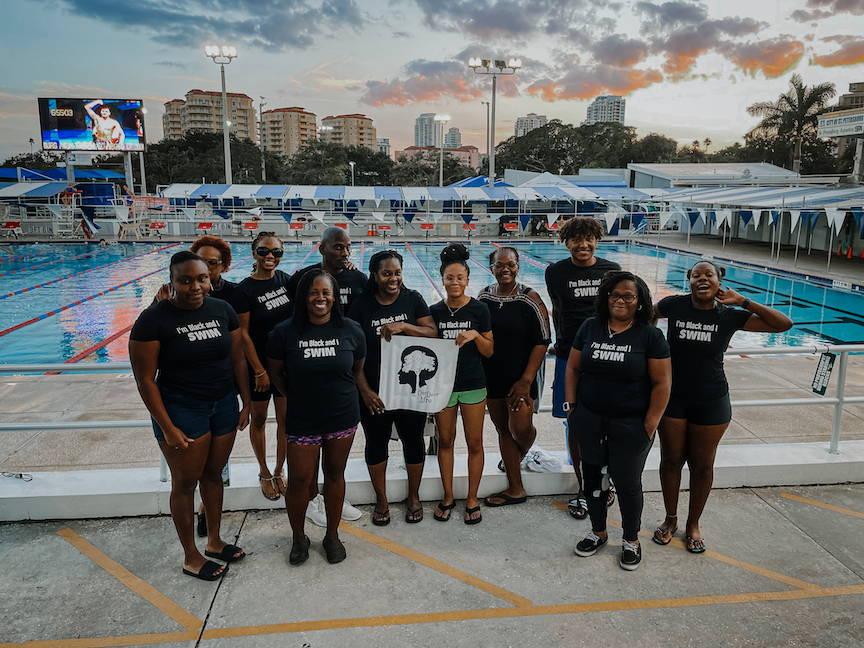
Through her leadership role as an Outdoor Afro volunteer, Van Dyke wanted to correct local history. As part of her weekend activities with community participants, she asked participants if they wanted to take adult swim and scuba diving lessons in the area. They did. “I have close connections with the city and wanted to be able to offer this to adults who never learned to swim,” the 2021 Outdoor Afro “Leader of the Year” said. “It’s very courageous of any adult to make the decision to learn to swim later in life. There are often deep-rooted traumas associated with our reasons as Black people for not learning early in life. So, I know it takes a lot for them to join our classes.”
LEARN ABOUT OUTDOOR AFRO MAKING WAVES PROGRAM
While participants take their swim lessons, Van Dyke shares the history and impact the Black divers had on Tarpon County. Reconnecting them to the group’s generational relationships with water. “They always find it very intriguing, especially knowing that none of this is being shared elsewhere.” Van Dyke dives deeper into history by mentioning that in the mid-1950s local officials received funding to build a ‘Negro-only’ beach. A move that happened after conflict of trying to integrate the area’s segregated beach arose. However, rather than using the funds to do so, officials instead built North Shore Pool, which was for white swimmers only.
A song and dance Black communities have seen and experienced firsthand for generations. From the famed Inkwell in Oaks Bluff, Massachusetts to the countless ‘swim-ins’ that took place across the South — longstanding evidence Black people and Black communities have a deep love of and natural links to waterways. Van Dyke serves as a continuation of Outdoor Afro’s mission to inspire and celebrate Black connections and leadership in nature. Changing the narrative that Black people “don’t do water.”