Jack and Jill of America Moms Connect with Outdoor Afro!

Recently Outdoor Afro has been delighted to connect with the Jack and Jill community, an historic African American mother’s group designed to promote social, cultural and educational opportunities for youth between the ages of 2 and 19 – and we are glad to add on connections to nature!
We were happy to have the chance to partner this season with a local group on a guided hike by Outdoor Afro leader Zoe Polk in Oakland’s Sibley regional park. Jack and Jill mom, Leslie Hardy Hood, said, “What a great activity, beautiful site and new exposure. Everyone felt good and I think it was a wonderful way to finish off the weekend. Many of the moms wanted to know about getting involved with Outdoor Afro.”

Headquartered in Washington, DC, Jack and Jill of America, Inc. has 230 chapters in 35 states and the District of Columbia, with a membership of over 10,000 mothers and associates and over 30,000 family members.
For more information about the organization, please check out their web page.

John Griffith Can Bust a Move - For Nature
A video of our friend John Griffith of the California Conservation Corp's has gone viral! Check it out!
Yep, John can pop and lock - yet importantly exude a genuine connection and close rapport with Outdoor Afro corps workers Antwon McCoy and Leonard Patton in his workforce development program.
Check out the salmon habitat restoration these amazing people have been up to, and how they are connecting with the mission of the Outdoor Afro community, thanks to John!
Beyond the video, I encourage you to explore John's other contributions that demonstrate his deep commitment to youth and the environment. As an author, he has written a children's book, Totem Magic: Going MAD that combines nature and fantasy told through a multicultural lens. John is also an insightful blogger, and his recent blog re-tells a heart tugging account of what happens when a young person sees a beach for the first time as a corps member.
We applaud and adore John, not only for breaking down a dance move, but for also breaking down barriers between people and our environment! Go John Go!

David Lindo: The Urban Birder
The real voyage of discovery consists not in seeking new landscapes, but in having new eyes - Marcel Proust
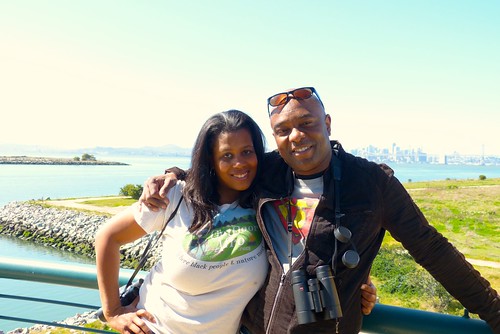
David Lindo, also known as The Urban Birder came to the San Francisco Bay Area yesterday to do a talk about his experiences birding around the world in urban centers, most notably in his hometown of London, England, where he is a well-known featured bird expert on television and radio. Lindo spreads the gospel of practical nature. Meaning, you don’t have to travel to exotic locations to find rare and delightful bird species. Instead, birds are wherever you are, and “all you have to do is look up”, he says.

As I briefly stood before the audience to help introduce the program, and looked out into the diverse faces of attendees, it provided a deeply satisfying glimpse into a not-so-distant future Outdoor Afro envisions, where all people engage with the nature all around.
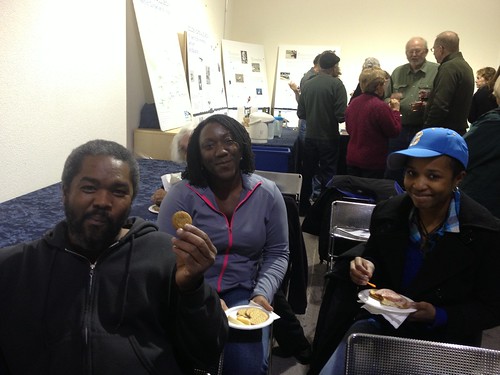
Generously sponsored by Golden Gate Audubon Society , an organization also committed to help more communities connect to conservation, the gathering proved to be a fun, fresh perspective on birding. David shared his personal story of growing up birdy as a youth, begging his working-class mother for his first pair of binoculars. A luxury his family could barely afford. He described the wonder of his special patch of woods, where he spent hours as a child getting to know his local bird species and making up intuitive names for each one. He went on to share through photos, examples of the variety of birds spotted in urban centers. He helped us imagine a skyscraper as a face of a mountain, where one might spot a Peregrine Falcon on its peak, and his humorous use of the Jedi-like “Force” to manifest rare bird species in some of the most improbable places.

Today, I was delighted to take David to see some more of our local birds. The previous day, Audubon staff treated David to a full-day of birding, where he found the male Varied Thrush pictured above, and our famous and rare Clapper Rail. Clay, an Outdoor Afro leader and ecologist joined us on the brief tour of Oakland's Lake Merritt and Middle Shoreline Harbor Park with panoramic views of the San Francisco skyline and bridge.

Hanging with two people who share deep experience observing birds was a kick for an intermediate like me. David and Clay debated the nuances of plumage to determine species. Is that a Golden Bellied Plover, or an American Plover? (they saw both). Yes, these are two black men from different parts of the world having this conversation, I mused.
While David has observed several hundreds of bird species with all types of people from many walks of life, remarkably, he admitted today was the first time he had ever birded with other black people outside of Africa!
It certainly won’t be his last.
Learn more about David Lindo The Urban Birder and Twitter @urbanbirder
We did it again, this time with a challenge...
By Alisha Pye, Los Angeles Outdoor Afro Leader

So we went hiking above the Mountain Gate Country Club again, but this time we decided to mix it up a bit. So we decided to go off the fire trail and hike the hills. This was a great hike although we had fewer people we had a very diverse group, ranging from a mom wearing her 6 month baby, to a 9 year old cross country runner.
This hike was particularly challenging for me because I'm very afraid of heights and cliffs, both of which we encountered. I would love to post pictures of the cliff but I was nearly paralyzed with fear. So here's to embracing fear and moving forward! Because of the challenge that I experienced, I think I enjoyed the hike more.
Overall, we hiked 11.3 miles, every time I even thought about complaining about the distance I looked up and saw this mom wearing her baby, a 9 year old and a grandmother or two chugging along. The diversity in this group was motivating to say the least. We didn't get a chance to stop and take a group picture, but we had a great time. The sun was shining, the sky was blue, the weather amazing and the scenery was breathtaking.


An Outdoor Afro Remembers a Visit to Birmingham
My name is Nkrumah Frazier. I am a member of the Outdoor Afro Leadership team. Recently I was perusing some older pictures on my computer and stumbled across some pictures taken back in July of 2007 when my wife (Chelsea) and I reluctantly dropped our kids off at my mother’s house and hit the road headed to Birmingham, AL. We did not have a weekend worth of activities, sites and destinations already planned out. We had only decided to go a few days prior. I won’t attempt to talk about everything that we did on the trip rather I’ll highlight the things that were the most memorable for me. With this month being Black History Month I thought that it would be rather poignant to write about this experience.
On the way to Birmingham we stopped just south of Tuscaloosa, AL at Moundville Archeological Park.  The Moundville site was once a settlement of Mississippian Indians on the Black Warrior River in central Alabama. At its most glorious, Moundville was a three hundred acre village built on a bluff overlooking the river. It was once a populous town, as well as a political center and a religious center. In size and complexity Moundville was second only to the Cahokia site in Illinois.
Moundville has been well taken care of over the years and was a really cool place to visit. There was an added bonus in the form of a series of nature trails in the form of raised boardwalks through the forests and overlooking the river surrounding the raised mounds. We made our way through the walkways soaking up all that the Alabama wilderness had to offer or as much as could be gleamed from the completely unnatural boardwalks jutting out from the landscape. Regardless of how unnatural the boardwalks were they were well done and lent themselves to a really wonderful time.
Alabama is a land of large beautiful rolling hills. We stopped at a site overlooking a river that displayed some of those beautiful hills and the awesome power that water is capable of producing. From there we drove on in to Birmingham. We found and visited the Vulcan statue; the largest cast iron statue in the world and city symbol of Birmingham. The statue reflects the city’s roots in the iron and steel industry. The 56-foot tall statue depicts the Roman god Vulcan, god of the fire and forge. It was created as Birmingham's entry for the Louisiana Purchase Exposition (1904 World's Fair) in St. Louis, Missouri. It is the seventh-tallest free-standing statue in the United States.
That evening we heard on the radio that the Ebony Black Family Reunion Tour just happened to be Birmingham that weekend. The event was emceed by Tom Joyner Morning Show’s Ms. Dupree. We were blessed to see performances from the likes of Cupid (at the time his song “Cupid Shuffle” was just hitting the airwaves, but we knew nothing about him), Glenn Lewis, Cherrelle, MC Lyte and Whodini free of charge.  It was a delight getting to see Cherrelle perform after growing up listening to her songs on the radio. At one point she was joined on stage by a young girl of about 8 or 9 from the audience. She talked about and displayed the not so subtle differences in the way the youth of today dance and the way it was done “back in the day”. The young girl danced her heart out and once she was finished Cherrelle attempted to show and explain to the girl and the audience that you don’t have to work so hard when you dance. She said that the way that girls and young ladies bounce and gyrate really hard and fast isn’t necessary. All that’s needed is a subtle and gentle swaying of the hips in tune with the music to achieve the desired effect!
MC Lyte then took full control of the stage. She came out and put on a display of lyrical prowess, stage presence and hip hop history that the overwhelming majority of the wanna be MCs on the radio today dream that they had and left the audience begging for more. Afterwards, Whodini stepped on stage and tore the proverbial roof off. I don’t feel I need to say anything else about that part of the show because, well…… it was Whodini! For the young people that may read this and wonder who Whodini is; I suggest you go and do a little research and then re-read this part of the story. Growing up poor in rural south Mississippi I was always behind the times when it came to music. Even the radio stations always seemed to be a little behind when it came to playing the latest music. Large musical acts never came to south Mississippi and even if they did I would not have been allowed to go. This concert to me was the embodiment of my childhood love of hip hop that I never got to experience and I’m thankful that I had this opportunity to see some of the greats of the business.
The next morning Chelsea and I woke up and wanted to do a bit more sightseeing before heading home. Chelsea being the history buff had a surprise in store for me. She wanted to see the famed Sixteenth Street Baptist Church. We drove around until we found the church, parked our car got out and walked the grounds. The Sixteenth Street Baptist Church was organized as the first black church to organize in Birmingham in 1873. During the civil rights movement of the 1960s, the church served as an organizational headquarters, site of mass meetings and rallying point for blacks protesting racism in Birmingham and throughout the South. On Sunday, September 15, 1963, members of the Ku Klux Klan bombed the church killing four young girls–Addie Mae Collins, Carole Robertson, Cynthia Wesley and Denise McNair–and injuring 22 others.
Adjacent to the church is a memorial park. This park was a memorial to the first the first American sailor killed in World War I, Mr. Osmond Kelly Ingram. In this park are statues commemorating the sights, sounds and activities of the civil rights movement in Birmingham. There were scenes portraying young black men and women being suppressed. One particular statue was of a young man being “arrested” by a policeman while simultaneously a police dog appears to be ready to bite down into this young man’s flesh.


Another set of statues consisted of police dogs in the act of lunging and barking at an “assailant” on either side of the circular walkway portraying a scene in which the dogs are attacking an invisible assailant standing on the walkway. I walked and stood in the middle of the statue and felt in awe of the power and majesty of the dogs that the statue is portraying. Immediately I began to try to imagine the fear that would undoubtedly arise within me if I were to be put in this situation with live dogs in real life.
There was a set of sculptures portraying a boy and girl being blasted by a water cannon. The sculptures of the boy and girl seem to portray the emotion that must have been experienced during such an event. Other sculptures include one of Dr. Martin Luther King and one of 3 preachers kneeling in prayer; a near by plaque reads “Place of Revolution and Reconciliation”. After leaving this memorial park we got back in our car and started the journey home. On the outskirts of town we looked back to see the Vulcan statue towering over the city bidding us adieu.
Having grown up in south Mississippi, I remember going to stores that wouldn’t allow black people to use the restroom. I remember hearing the “N” word being used in a very derogatory manner. I’ve heard stories and actually seen how ugly hatred based simply on the color of a person’s skin can really be. I remember thinking about the struggles that took place so that I’d be afforded the opportunity to walk among a memorial depicting this not so pretty side of human nature rather than having to live it first hand. I can’t help but think that the younger generations really don’t have a clue what it was like during those struggles.
For that reason I’m proud to be an Outdoor Afro. I’m proud to be an ambassador for my people. I am proud to be a part of the effort to reconnect; and in some cases to connect, black people to the natural world. But in some ways this effort is about more than just connecting black people to nature. This is about removing some of the misunderstanding, the misconceptions that some individuals have about black people. This organization serves to point out that black people are after all just people and in that light Outdoor Afro serves to bring us all closer together by showing us that we are all relatively the same. After all; the conversation we are attempting to have is merely a focused conversation; not an exclusive one.
Additional photos from this trip can be viewed in the Facebook album that was created.
Falling in Love with Lassen!

Lassen Volcanic Park continues to be the hidden gem enjoyed by the Outdoor Afro community. For the second year in a row, we partnered with National Park Service staff to lead a snow shoe walk among in the park’s beautiful red fir forest and for the second year in a row, we had a blast!
When we first arrived, Rangers Chris and Caitlin greeted us and explained the history of snow shoeing, including their use in Native American culture.
After all of us were fitted with our snow shoes, we made our decent in the wilderness where we learned about how the forest’s inhabitants survive in the winter and what humans can learn from them.

For example, Ranger Chris talked about the incredible memories of Steller Jays and Clarks Nutcrackers, who can store their food in several places throughout the season and remember where to find to find it when they return in the winter. All of us felt a sense of awe and warmth learning that we were in the park during the time that Black Bears were giving birth in their dens. In addition, we learned about the Sierra Nevada Snow Shoe hare, which changes its fur from brown to white to camouflage itself in the winter and relies on its large feet to keep from sinking in the deep snow.
There were so many memorable moments during the one and half hours that we all spent together, including shared stories, supporting hands, jokes and a few graceful falls. While the wind picked up from time to time, we were energized and warmed by each other and gave and received smiles throughout the hike. 
One aspect that I will never forget is the enthusiasm of Al, an Outdoor Afro from Tracey. While we were on the snow shoe, he saw a large hill in the distance that he wanted to ascend. While some of us wanted to conserve our energy for the return trek back to the visitor center, Al led a small delegation to the top of that peak. By the look on his face, you can tell he enjoyed that little jaunt!
Before we returned to the visitor center, the Rangers showed us some snow caves that had been dug by some of the school groups that had visited Lassen Volcanic Park. Snow caves are equal parts tunnel and holes dug in the snow for shelter and warmth. Here’s our adventurous Al again checking out the wintry accommodations

For me, the most surprising lesson learned was that Lassen Park, despite being one of the oldest parks in the country is also one of least visited. I encourage more people to take advantage of all the park has to offer. First, on the drive to Lassen, you are treated with an absolutely breathtaking view of Mount Shasta. Moreover, the park offers so much in terms of activity. In addition to snow shoeing, we enjoyed the cross country skiing, sledding and the beautiful and information filled visitor center. Not only were we impressed by the beauty of the forest, we also admired all of the volcanic peaks surrounding the visitor center including Brokeoff Volcano and Prospect Peak. The Rangers invited our group back during the summer for the Lassen Dark Sky festival which will include nightly constellation tours and stargazing. Its just one of the many great reasons to visit the park during any season.
Thanks so much to the Lassen Volcanic Park staff for preserving this sacred space. And special thanks to all of the Outdoor Afros who made this trip so enjoyable!


When Camping Goes Wrong
Sometimes things just don’t go according to the plan.
You can buy or borrow almost any product that adapts to an outdoor lifestyle and experience, but sometimes oversight, lack of experience, or unexpected weather conditions can cause the best laid camping plans to run afoul.
Like forgetting a can opener when camp meals depend on canned goods or arriving at camp to find the tent poles never made it into the car, and heaven forbid there is no wine or bottle opener!
I’ve lived through a few camping mishaps of my own.

For example, I can now (after 20 years) fondly recall a car camping trip along the California coast with my University Women’s Center staff back in college when I was 19. We were so determined to do the trip – women can and will do anything was our internal motivating mantra. And in the face of an incoming storm, a little predicted rain and cold was not going to stop us!
The day of our trip, I dug out and threw my 2-person hand-me-down day tent and sleeping bag into the car. Our group stopped at a Safeway along the way where we impulsively filed our basket with every comfort food and drink we could find.
By the time we reached camp with our bags of groceries, it was late afternoon, and light rain had begun to fall. I do remember how beautiful the redwoods were, filtering rays of sunlight on our camp.

But the rain picked up toward the evening, extinguishing our fledgling fire. The air chilled in character and on queue for the region. So an early retreat to our tents was the best option– or so I thought, until I discovered my tent had a small leak.
I managed to plug the hole with tape, and rearrange my belongings and sleeping bag away from the moisture, forcing me to curl up on one side of the tent.
I knew it was going to be a long night.
After drifting off to sleep for a few hours, I woke to the sound of pouring rain and a soaked sleeping bag. Now, my tent was leaking all over, and without a tarp beneath me I felt moisture from the ground seeping in. All my earlier feminist bravado came to a screeching halt. I was wet, cold, and groggy. And as far as I was concerned, our camping trip had come to an end.
Thankfully, I've learned a lot since those early days of planning camping trips on my own as a young adult. Camping with my children over the years has necessarily sharpened my skills. I now make sure we have the right tools for the type and location of camping we do. Thinking back, I know that with some basic skills, research on where we were going; packing the right tent (tarps!), sleeping bag, and better layers of clothing, our camping trip would have been a more dry and cozy adventure versus a cold and wet one.

This is one reason the correct gear and the knowledge of when and how to use it matters. If you don’t have a camping role model in your friend or family network, many REI stores, and organizations like Outdoors Empowered Network are answering the call with free and low cost gear closets and technical assistance to help groups like my Women’s Center crew get camping right the first time so participants can look forward to participating again and again.
Has camping ever gone awry for you? How did you make the best of it? – Or did you roll up your sleeping bag and go home? Leave a comment and tell us!
Apply to Join the Outdoor Afro Leadership Team Today!
Do you have a passion for the outdoors and want to share it with others?
Consider applying to join the 2013 Outdoor Afro Leadership Team today!

In 2012, we successfully launched the volunteer Outdoor Afro Leadership Team of 13 folks - the OALT, who formed a team of "experience ambassadors" for Outdoor Afros all around the country. Between May and December of 2012, this team led 500 people to nature right in their own backyards, many for the first time, thanks to these inspiring outdoor role models and our generous sponsors! (see below!)

As you know, Outdoor Afro supports a vision of outdoor recreation and conservation engagement for everyone, especially for the African American community. At Outdoor Afro, we can provide leaders a platform and the support to help others reconnect to natural spaces right where they live. Leaders can learn to be a role model for camping, hiking, kayaking, birding, fishing -- or any other recreational activity to share with others.

We are specifically interested in leaders who can represent the New York, Washington DC, and Pacific Northwest regions, but members from all US metropolitan regions are welcome to apply!
Here is what we require:
- Facilitate 1-2 OA sponsored events every two months
- Contribute to blog entries and social media
- Participate in a monthly conference call with other OA Leaders
- Help to further the mission and exposure of OA throughout local communities
Leader perks include:
- Select FREE premium gear and supplies from sponsors KEEN Shoes, REI, and Clif Bar
- Professional support, coaching, and outdoor skills development opportunities
- The ability to make a tangible and positive difference for communities and the natural world
Apply now to join our diverse team from around the nation to bring the outdoors to more people in your community.
Next Steps to be Eligible for Consideration:
- Complete the application and submit via email by Friday February 22nd and participate fully in the interview process via video conference
- Be available for a mandatory in–person training from April 19-21 in Northern California
The 2013 Class of Outdoor Afro Leaders will be confirmed and announced in March, 2013.
For any questions please contact [email protected]
The Outdoor Afro Leadership Team is possible because of the generous support of:
Toyota Audubon Together Green
KEEN Shoes
Clif Bar
REI
The Golden Gate Audubon Society
Geocaching Your Way Through Black History
What exactly is Geocaching, you ask?
"Geocaching can be a fantastic way to spend some time outdoors, discovering and learning more about your world, in places both near and far, alone or with family and friends. It’s like treasure hunting, but the treasure is the experience."
Guest Blog by Cat Clark tells us more about it!
When the weather in the Washington, DC area is mild, it allows me to enjoy one of my favorite outdoor activities: Geocaching!
Geocaching is a kind of high-tech scavenger hunt. Participants use handheld GPS receivers to find hidden containers (geocaches) of varying sizes all over the world, sign the logbooks inside, and share their adventures on websites such as Geocaching.com. And geocachers hide caches everywhere-- from national parks to the city streets. Chances are good that you've passed within a few feet of several geocaches without ever realizing it. It's a fun, family-friendly way to spend some time outdoors wherever you are.
One of the things I love most about geocaching is that it's so much more than an outdoor game to play with family and friends. Geocaching leads me to amazing places I might not have otherwise visited or noticed. I've found caches in exquisitely beautiful small parks and in curious locations such as a mausoleum in a hotel parking lot (true story!). But some of my favorites are the ones that lead me to historic landmarks. Just recently, my geocaching adventures sent me to some local Black history sites.
The first cache was hidden near Ben's Chili Bowl in Washington, DC, the famed restaurant frequented by Duke Ellington, Miles Davis, Ella Fitzgerald, Cab Calloway, Nat King Cole, Redd Foxx, Dick Gregory, Martin Luther King Jr., Donny Hathaway, Roy Ayers, and Bill Cosby. During the riots that followed the assassination of Dr. King, Ben's was allowed to stay open after curfew to provide food and shelter for activists, firefighters, and other public servants. Visiting Ben's is a must for all DC tourists, and the food is fantastic. I'd eaten there before, but I was grateful that geocaching gave me yet another reason to grab a chili half smoke! The amazing history of Ben's Chili Bowl is summarized on Ben's website:
The second Black history cache I visited was at the home of educators and civil rights activists Dr. Edwin B. and Mary Ellen Henderson in Falls Church, Virginia. Dr. Henderson was the first African American to be certified to teach physical education and argued passionately for equal opportunities in thousands of editorials. Mrs. Henderson, an educator in Falls Church's segregated school, fought for 29 years to have a new school built for Black students. Falls Church's current middle school is named for her. The Henderson House was recently nominated to the National Historic Register of Historic Places and Virginia Landmarks Register. Check out the Henderson House on Waymarking.com
The third cache, very close to the Henderson House, was hidden at a granite arch I pass frequently in my car but had never stopped to investigate. It turned out to be a monument honoring the men and women of Tinner Hill. In 1915, local Black citizens-- led by Dr. Henderson (see above) and Joseph Tinner-- formed the Colored Citizens Protective League (CCPL) to fight housing segregation ordinances. This group became the first rural branch of the NAACP in the nation. You can read more about the inspiring monument and other local history sites on the Tinner Hill Heritage Foundation site.
Previous geocaching outings have taken me to the Freedmen's Cemetery and African American Heritage Park, the latter quite close to a beautiful sculpture of abolitionists Emily and Mary Edmonson, in Alexandria, Virginia.

Geocaching can be a fantastic way to spend some time outdoors, discovering and learning more about your world, in places both near and far, alone or with family and friends. It's like treasure hunting, but the treasure is the experience.
Want to give it a try? First, visit Geocaching.com to read Geocaching 101 and set up a free account. If you don't have a handheld GPS receiver but have a smartphone, some great geocaching apps are available. I'd also recommend investigating some online tutorials and tips posted by friendly geocachers around the web, such as HeadHardHat's "Geocaching Basics and Geocass' "GeoCaching with the iPhone: Preserving Battery Life". Don't be intimidated, just start with some regular-sized, traditional geocaches with easy difficulty and terrain ratings (1 to 2 stars). After you've found a few caches, you will get the hang of it!
If you get hooked and you're thinking about investing in a handheld GPS receiver for geocaching and other outdoor activities, don't forget to ask about GPS navigation classes at outdoor sporting stores such as REI.
More interested in finding the history than the geocaches? There's another option for you! Visit Waymarking to get the coordinates for millions of interesting locations. Just plug in some keywords and a location and you can custom-design a tour you'd never imagined possible. Did you know about the Glen Echo Park Civil Rights Protest? You can visit the restored carousel yourself!
Happy hunting!
Cat Clark
Outdoor Afro Contributor for Black History Month