Lisa Bourne appointed first operational executive director
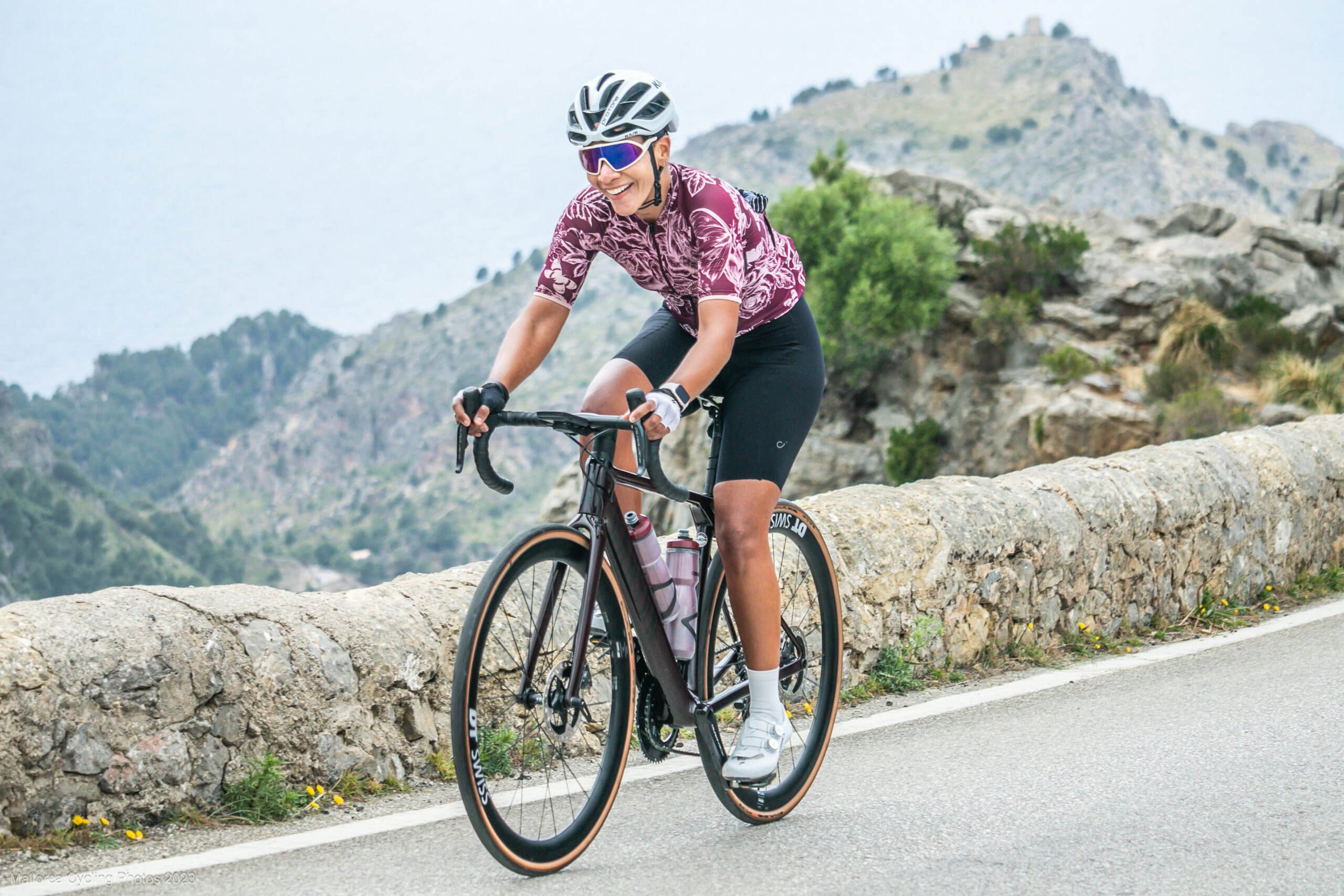
The hardcore cyclist pedals into national not-for-profit Outdoor Afro as its operational executive director – a history-making role for the now 14-year organization. "I'm truly humbled and grateful for the opportunity to assume leadership of the Outdoor Afro organization during this exciting time,” said Lisa Bourne. “Outdoor Afro's mission grounded in Black excellence, education, and leadership resonates with me on the deepest levels.” Bourne’s appointment started Feb. 13 with the Oakland organization after a four-month nationwide search with recruiter Cause Capacity.
In this role, Bourne will support strategic growth efforts and oversee operational efficiency to meet Outdoor Afro’s moment of rapid growth and demands for its programs and staff. Bourne will work in partnership with Outdoor Afro’s Founder and CEO Rue Mapp, key board members, and current staff, serving as an internally facing leader to guide the strategic implementation of best-in-class, not-for-profit operations. With Mapp continuing as the organization’s CEO and spokeswoman, Bourne will construct and manage the necessary infrastructure to enable Outdoor Afro advancements in national programming and network participation across the United States.
“In this ‘Year of Elevation,’ Lisa joins us at the right time,” said Mapp. “We were searching for a passionate and talented executive leader who is also a savvy and proven organizational manager. I truly believe we’ve found the best person for the job.” With a master’s degree in business administration from Harvard Business School, Bourne brings 20 years of progressive experience in corporate, nonprofit, retail, E-commerce, and consulting leadership roles. Prior to this post, Bourne served as senior director of diversity, inclusion, and social impact for Zwift – a virtual cycling and running training app; director of omnichannel marketing for luxury department store Bergdorf Goodman; and vice president of E-commerce, sales, and marketing for Akola Project, Inc.
She also held management positions with brands such as Amazon, Fossil, and The Neiman Marcus Group. An avid cyclist, Bourne inspires and motivates others by riding 3,000-plus miles per year. She has volunteered as a cycling ambassador to drive diversity and inclusivity within the sport. “I'm thrilled to be able to continue to align my passion with my career,” Bourne said, “leveraging my strategic, operational expertise for such a beloved and highly regarded organization." Bourne became the newest hire for the national organization and network.
Outdoor Afro started as a social enterprise for Mapp in 2009. She incorporated the organization in 2015 as a 501(c)(3) and has led the organization since as its CEO. The organization has grown from a one-woman blog and three founding board members to 12 full-time staff and a 13-member Board of Directors. Its operating budget has grown from a modest $110,000 in revenue in 2015 to now more than $2.5 million – largely from foundations, individuals, and corporate partner support. “This position is groundbreaking for Outdoor Afro,” Mapp said. “Lisa will have the ability to help the organization expand our growth and capacity. Her role is the model for how we plan to fulfill our operations for today’s Outdoor Afro experiences and programs.”
ABOUT OUTDOOR AFRO: Outdoor Afro is a national not-for-profit organization that celebrates and inspires Black connections and leadership in nature. What started as a kitchen table blog by Founder and CEO Rue Mapp in 2009 has since grown into a cutting-edge nationwide network with 100-plus volunteer leaders in 60 cities with network participation reaching 60,000 people. Outdoor Afro reconnects Black people with the outdoors through outdoor education, recreation, and conservation. Follow Outdoor Afro @outdoorafro and outdoorafro.org. Lead photo by Ottilie Quince.

Nature Champs: CLIF® Athlete Venus Williams, Outdoor Afro
Consider Virginia Key Beach as the response to white-only swimming pools and water recreation. In the middle of the 20th century, this Miami vacation destination for Black people granted access to boating, fishing, surfing, swimming, and beachside lounging. A way of life for generations of Black nature enthusiasts and Black wealth to thrive – even while segregation tormented the country. Outdoor Afro revisited this historical landmark summer 2022 with partner CLIF BAR® and CLIF® Athlete Venus Williams to reflect on Black joy and healing in nature-rich places.
“What an honor to not only share the day with Venus but with our Founder and CEO Rue Mapp,” said Outdoor Afro volunteer leader Sierra Taliaferro with binoculars ready. “I wanted to do my best to provide a memorable experience in my backyard of Miami." Joined by fellow volunteer leader Michele Nedrick, Taliaferro led Outdoor Afro community participants, Mapp, and the tennis star through the beach’s nature trails and cultural history. Taliaferro helped the group identify native flora and fauna in between genuine conversations to learn more about each other.
A Miami transplant, Taliaferro spends most weekends exploring area routes. Like the Outdoor Afro activities she hosts monthly, this partnership experience allowed both Taliaferro and Nedrick to introduce new CLIF BAR® and Outdoor Afro staff to local stories and species of the beach. Decades of it. “Virginia Key Beach is not only historically Black,” Taliaferro said, “but it’s monumental to our sometimes forgotten history.” The recreational site became a cherished safe space in the 1940s onward for Black beachgoers of the states to Black immigrants of South America, Cuba, and various Caribbean islands.

It wasn’t until 1982 that the city of Miami closed the beach because of “rising maintenance costs.” After a decades-long fight by the Virginia Key Beach Civil Rights Task Force, the beach landed on the National Register of Historic Places in 2002. It reopened to the public in February 2008. An ideal spot for Nedrick and Taliaferro to host Outdoor Afro network activities yearlong that naturally strengthen the neighborhood’s connection to its land, water, and wildlife. In rhythm with typical network hikes, Nedrick and Taliaferro started the day with Outdoor Afro’s signature opening circle of introductions. Then, their educational and transformative tour meandered through sandy tracks and prickly-ash plants.
Occasionally, migrating birds and zebra longwing butterflies fluttered by the group as insect sounds amplified the ambience of the tropical wilderness experience. A fervent birder, Taliaferro often used her “field glasses” to identify native feathered friends for the day’s company. Since the beach is right on the coast, water birds were the easiest to pinpoint: white ibises, double-crested cormorants, and black-crowned night herons. “I often emphasize to beginner birders that birding is unconventional,” said Taliaferro. “You literally can do it anywhere. Even from your backyard.”
What led to this moment of Outdoor Afro volunteer leaders – sharing their expertise about this place of purpose for Black people – and CLIF BAR® goes back nearly a decade ago. CLIF BAR® and Outdoor Afro have been partners since the network became a national not-for-profit organization in 2015. Continuing to grow the partnership, CLIF BAR® created CLIF CORPS. This initiative is CLIF’s employee-led community service program where CLIF® Athletes donate time and resources to support nonprofits that make the spaces they live and play in more accessible and inclusive.

Williams serves as a CLIF® Athlete and has been a fan of Outdoor Afro for some time now. The perfect recipe to have a Black joy (and Black history) moment in nature: “I am honored to be part of this new chapter of CLIF CORPS and to support Outdoor Afro’s work to show greater representation in the outdoor community,” said Williams. “Together we will make a meaningful impact to reconnect Black communities with the outdoors and sports through education, recreation, and conservation.” The CLIF CORPS partnership features a series of ongoing giving and service amplifications with community groups like the Women’s Sports Foundation and National Parks Service. The goal is to provide opportunities for people across the United States to participate in activities otherwise deemed inaccessible or unwelcoming for social, emotional, or economic reasons.
Throughout this year, Outdoor Afro volunteer leaders will guide CLIF-supported outdoor experiences across its four regions: Midwest, Northeast, South, and West. Activities range from biking, kayaking, and hiking. "A recent study led by Penn State found that 1 in 5 Americans have taken on a new outdoor hobby since the beginning of the COVID-19 pandemic. However, many Americans are unable to experience these benefits due to inequities in access to the outdoors and sports,” said Jodi Olson, Vice President of Brands at CLIF BAR®. “That’s why we are collaborating with Venus Williams and Outdoor Afro, two of our long-time partners, to enact change and break down systemic barriers, creating more diverse and inclusive activities for our communities.”
Williams and Outdoor Afro took a beach walk. A few community participants showed off their driftwood tightroping abilities. When everyone made their way back to the initial opening circle location, the space created a new appreciation for Black contributions that developed the beach. The seaside stroll reinforced the everyday work Outdoor Afro does to celebrate and inspire Black connections and leadership in nature. Taliaferro wrapped up the evening by sharing that “nature allows us to see not only the surrounding beauty, but also the beauty in ourselves. Nature is truly a reflection of us.”

10 beginner swimming pointers from leader Mardi Fuller
As summer draws nearer, anticipation for beach, pool, and lake days grows. Nationwide, Outdoor Afro looks forward to time outside with family and friends – as well as the wonder of weightlessness and the joy of cooling immersion that the water provides. Our network is in constant pursuit of deeper connections to nature, bringing Black people together in community and water-focused activities. Black people have faced exclusion from public pools and beaches over the course of the 20th century. Swimming areas were segregated through the 1960s, and Black people did not benefit from the pools and swim clubs built in white neighborhoods either. This deliberate prohibition has resulted in a great disparity in who has access to swimming and water safety, and by extension, the many sports and activities for which swimming is a foundational skill. I like sailing, fishing, kite surfing, or water polo.
Outdoor Afro is working to change this through its Making Waves program, a program designed to help increase access to swimming for Black families across the United States. The program provides swim scholarships to children and their caregivers. Learning to swim is first about survival: knowing how to gauge safe swimming conditions, gaining water confidence, and moving efficiently in the water in a relaxed manner. Once achieved, swimming opens the door to a new world, truly, as 70 percent of the earth is covered by water. It has been called the best form of exercise because it’s easy on joints and builds muscle tone all over as the body works against the water’s resistance. I am fortunate to have had my mother take my brother and me to swimming lessons when I was around 3 years old.
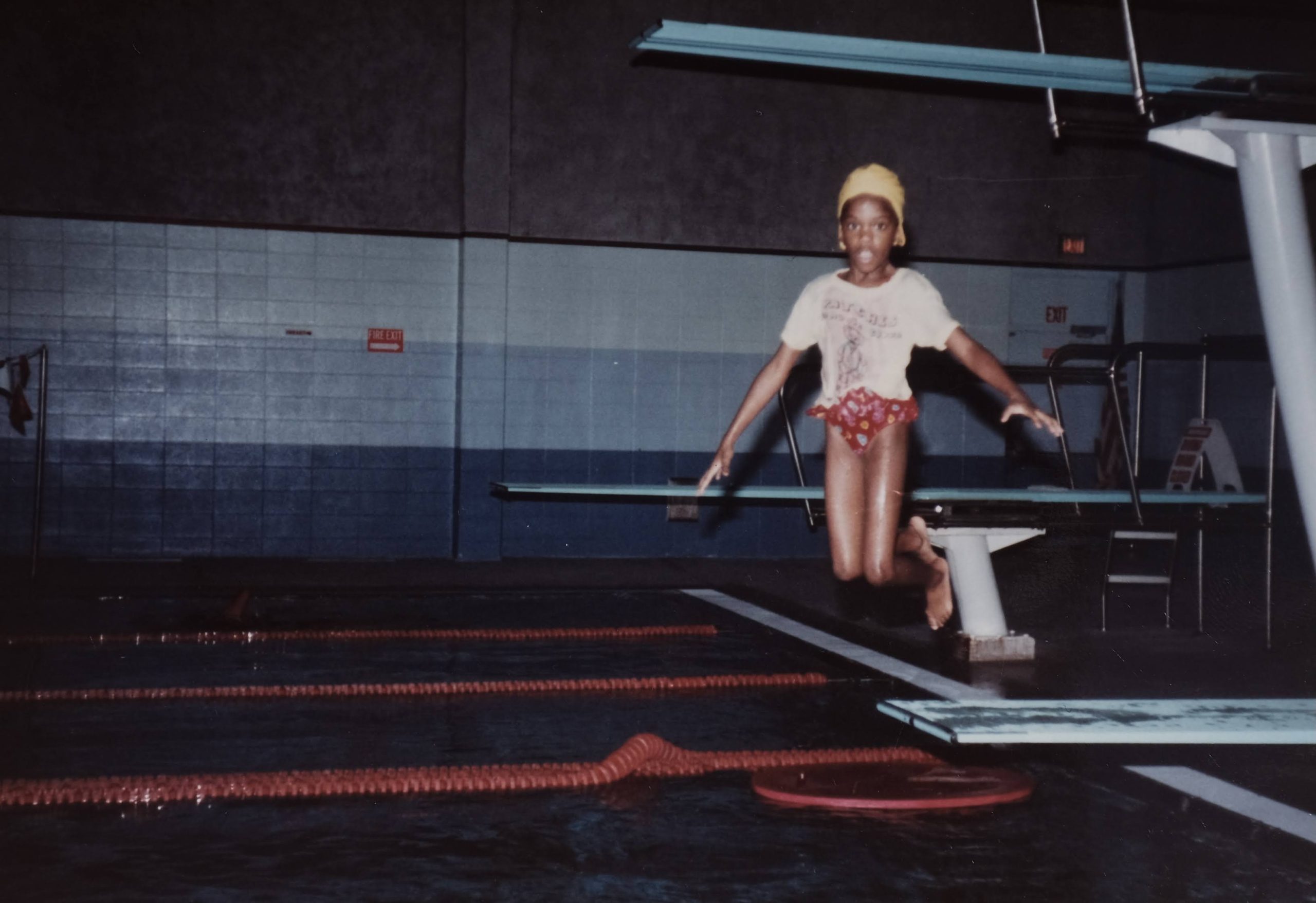
My mom didn’t know how to swim and took classes at the same time. To this day, swimming is the exercise in which she finds the most ease, and it has helped her manage chronic pain. Swimming has been a refuge for me as well. As a kid, I was always happiest when playing in any body of water, and I participated in swim teams throughout childhood. I became a lifeguard and swim instructor in high school and college. These roles allowed me to be around the water and were some of the best paying jobs around. In adulthood, I now swim for exercise and injury management; I’ve swam in triathlons, and I still enjoy open water swimming. Above all, it’s always brought me massive joy. If you are a beginner swimmer looking to increase your water confidence and have more fun at the beach or pool this summer, here are my recommended tips to get started and build a rewarding lifelong relationship with water:
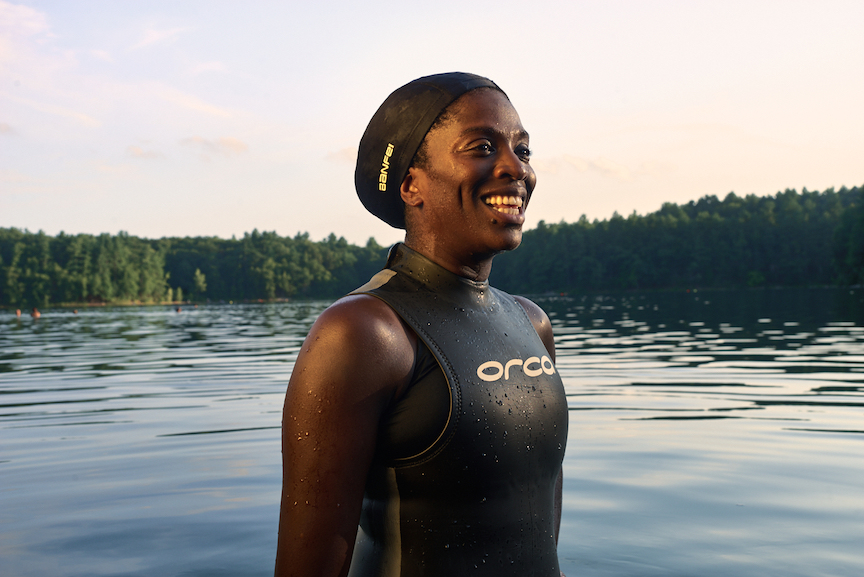
CHANNEL YOUR ANCESTORS. The most important thing for you to know about swimming is that you belong in the water; it is your heritage. Historically, West Africans were proficient swimmers at a young age. Swimming, boating, and fishing were integral to our cultural practice, including spiritual beliefs, economies, social structures, political institutions and worldviews. In Undercurrents of Power: Aquatic Culture in the African Diaspora, Professor Kevin Dawson’s research reveals how descendants of Africans demonstrated aquatic fluencies at home as well as while enslaved in the Americas. West Africans built and navigated the waters in dugout canoes. They spear fished. They evaded enemies by swimming. Reading this scholarship brought new meaning into my understanding of our powerful water-based legacy.
LEARN THE FUNDAMENTALS OF WATER SAFETY. Understanding the risks of being in and around water is the first step to becoming a strong and safe swimmer. Familiarize yourself with water safety tips from the American Red Cross, where you will find a national database of swim instruction available near you.
FLOAT ON. AND ON. AND ON. Once you’re comfortable in the water, floating is a survival technique as well as a restorative practice. You can float when you’re too tired to swim anymore, and you can float simply to relax and be present in your surroundings. Practice by laying on your back in shallow water with arms and legs extended. Have an experienced swimmer support you by standing next to you, gently placing a hand under your lower back. Press your hips to the sky. Cup your hands slightly, fingers together, and slowly move water towards your body, and then flip your hands and push water away. This is called sculling. Each body floats differently, depending on muscle mass, body fat percentage and your body’s surface area. Most people can’t float without some gentle movement, such as sculling or a gentle flutter kick. Practice and discover exactly how much movement it takes for you to float with ease.
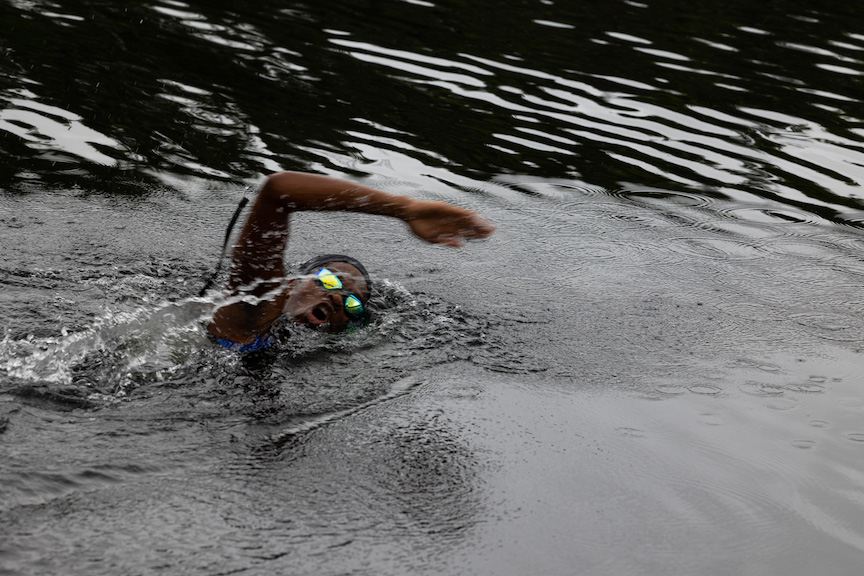
JUST BREATHE. After learning to float, your next priority is regulating your breath. Once you do so, the experience of swimming can be quite calming and beneficial to your overall health. Swimming increases lung capacity and breath endurance. Interestingly, one study compared swimmers’ lung capacity to that of elite football players and found that the swimmers had larger lungs and better cardiorespiratory function.
PRACTICE BLOWING BUBBLES. Swimming proficiently for any length of time requires putting your face in the water. You can try this at home. Fill a basin with water and get comfortable dunking your face right in. Whenever your face is in the water, you are always blowing air out of your nose and mouth – never holding your breath. After you’ve pushed the last drop of air from your lungs, lift your head out of the water and inhale through your mouth slowly. Repeat. As you gain comfort, practice turning your head to either side to inhale, as you will when you learn the crawl stroke or freestyle stroke.
TAKE A SHOWER. We are not trying to have damaged hair or dry, ashy skin. Not only is it good hygiene to rinse yourself off before going into a body of water, but also allowing your hair and skin to absorb fresh water means that your cells and follicles have less room to absorb damaging chlorine or salt.
TRY TO CREATE GOOD CONDITIONS FOR LEARNING. Your local YMCA, YWCA, or community pool will offer lessons for children and adults. Outdoor Afro even offers “Swimmerships™” (swim lesson scholarships) through its Making Waves program. If you have options, shop around and find an instructor you’re comfortable with and in a supportive learning environment at that. It can feel hard to try to learn a new skill as an adult, too. Settle into a mindset in which you’re patient with yourself and open to learning and growth. Find a bathing suit you feel good in. Check out Black-owned soulcap.com for swim caps designed to fit our various hairstyles and hair volumes. Get a pair of swim goggles to protect your eyes from chlorine and to make it quicker to transition between being above and under the water.
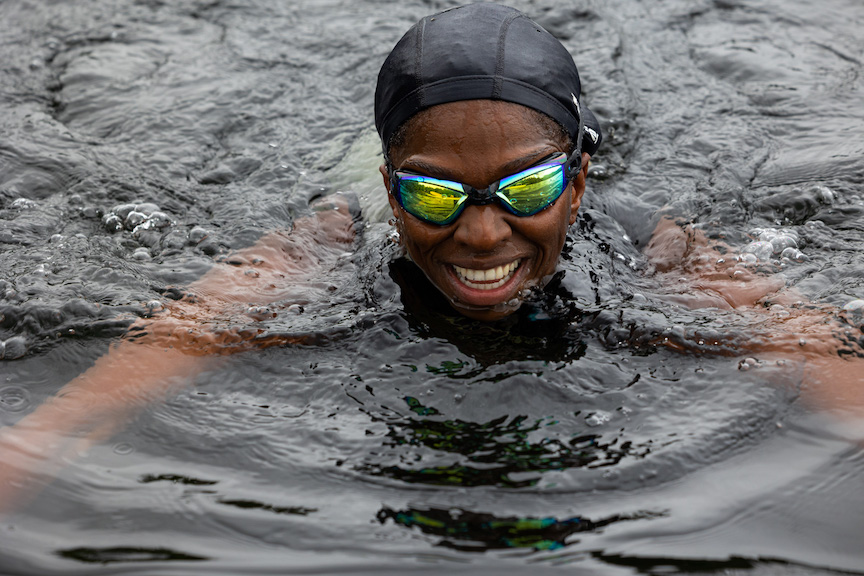
WEAR FINS. When you’re practicing on your own, fins are a great support to use to learn how to kick. When you kick with fins your body naturally executes a flutter kick emanating from your core and hips. It’s easy for beginners to want to bend their knees to kick – a motion which will get you nowhere.
AVOID FLOATATION DEVICES. You will find varying opinions on this, but my opinion is that flotation devices are important for safety on open water, but while learning to swim, they can provide a false sense of security. Children who wear floatation devices often feel overconfident in deep water before they are truly able to keep themselves safe at that depth. Wearing a floatation device may tempt a new swimmer to not pursue stronger skills. Better to stay within a swim area where you can stay safe. Progress to deeper water as your skills advance.
DON'T STOP PRACTICING. Learning how to swim takes consistency – some estimate it takes 75-100 hours of lessons and practice to become proficient. It may take five years of swimming once or twice a week to become a comfortable lap swimmer, but you’ll become strong enough to be safe and enjoy yourself well before that. And of course, have fun! Find your own water joy, whether it is the peace and quiet that comes from ducking underwater, riding waves in the ocean, or floating for relaxation. Or picking up a sport like stand-up paddle boarding or windsurfing. Oh! And don’t forget to bring a friend or family member along with you.
Underwater, action shots by Joe Klementovich: @klementovitch; portrait shot by Philip Keith: @philipckeith_

Machine Falls: where endurance hikers, leaders are born
The accordion-like hike chugs along with ease. Then, a collective cautiousness seeps in. Ahead, a 60-foot descension. Disjointed stones, hard-to-identify wooden staircases, and protruding tree roots offer occasional guidance with each unsure footstep. A steep, jagged drop any hiker would question. Then, her voice echoes toward the group: “Take your time,” said Outdoor Afro volunteer leader Danielle Young, 35. “There’s no rush.”
“Whew!” Some blurted. “Thank goodness!” Another wave murmured under their breath. Once that part of the hiking gauntlet completes, everyone temporarily lands back on solid ground. Young gives clear direction for this next part: It’s slippery entering the water. Which, by the way, comes to one's knee. Something she gave notice about weeks before on Outdoor Afro’s Tennessee Meetup page.
“So walk slowly,” Young said. “I will be there at the halfway point to tell you where to go next.” A woman of her word, she does. For the last time as an Outdoor Afro volunteer leader. An assignment she now passes to new 2022 volunteer leader Danae Gaiter, 36. After a few mental scares and semi-water treading hesitations, the party of nearly 15 community participants arrive at their destination: Machine Falls Loop Trail in Tullahoma, Tennessee. Roughly an hour drive from Nashville.
The aerospace and aviation hub in Southern Middle Tennessee is home to the world's most advanced flight testing center. Railroad construction actually created the community, which chartered in 1852. However, the city’s surrounding springs became popular tourist attractions alongside its growing avionics history. Machine Falls became one of Tullahoma’s many challenging sightseeing routes and waterfalls visitors wanted to test. Explore water life (creek beds and smaller waterfalls), fauna, and flora as pluses to the trail.
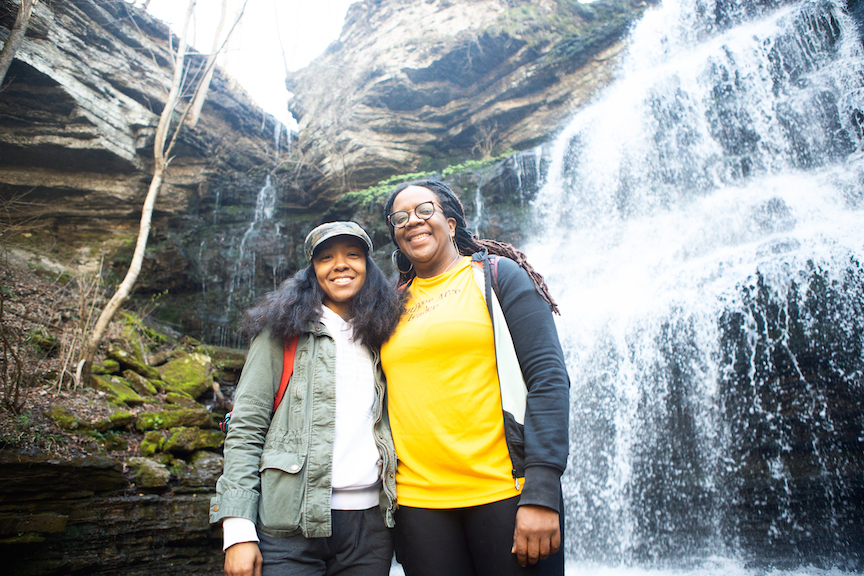
Positioned off a 4.1-mile loop, the more than 60-foot-tall waterfall is a top Outdoor Afro activity on Tennessee participants' to-visit list. For the past three years, Young has guided those interested in the destination on Outdoor Afro weekend adventures. COVID paused group trips to Machine Falls until recently. However, Young found personal peace at the waterfall while waiting for network events to start again. Outdoor Afro has helped Young in present times of grief.
“Logging offline and heading into nature is just soothing, especially with everything that has been thrown at me,” said Young, a cyber defense major. Because Young plans to move closer to her sister who lives in Texas, she recommended Gaiter as her volunteer leader replacement. Gaiter, who participated in her very first Outdoor Afro activity in November 2021, accepted. As network events posted to Meetup, Gaiter joined more journeys with Young. Refreshed. Inspired.
“It felt so good to be with like-minded people,” said Gaiter. “Breathing in the early morning air. That sense of being welcomed. Getting all my questions about nature answered.” Sold on taking Young’s place, Gaiter applied to become an Outdoor Afro volunteer leader. After many screenings and interviews by the networks’ national program director, Chaya Harris, Gaiter joined the Class of 2022 volunteer leaders. Totaling 117 volunteers this year. Next, Gaiter hopped on a flight to Granby, Colorado, for Outdoor Afro Leadership Training (OALT) held at River Run RV Resort.
Another weekend experience but for selected and trained applicants to gain the essential tools needed to guide local communities in nature sustainably and safely. The training is organized annually by Outdoor Afro staff and experienced volunteer leaders who share the organization's history, values, best practices, and industry knowledge, including: trip planning basics; health impacts of nature conservation ethics; risk management; and effective social media storytelling. Select partners and guest speakers are invited to the training to provide field insights, and share inspiration and encouragement.
After training, volunteer leaders like Gaiter create and guide monthly trips that foster local program collaborations, and help strengthen community relationships with land, water, and wildlife. Volunteers center joy and healing, disrupting a false perception that Black people do not have a relationship to nature. “I’m really big on making people feel comfortable,” said Gaiter. “We belong in this space. I look forward to reassuring our participants that there is safety in numbers within group experiences.” Gaiter’s contributions are part of Outdoor Afro’s 60,000 participation network.
The national not-for-profit organization spans 60 cities across the country. Located in 32 states, including Washington, D.C. That moment at Machine Falls where participants made it safely and together to the cascading water scene is what OALT prepares volunteer leaders for. The arduous hike left 67-year-old Jesse Green Jr. of Nashville in anticipation for the local network’s next nature quest. “I could have stayed at that waterfall all day with Outdoor Afro,” said Green Jr., a former YMCA certified swim instructor trainer. “I loved hearing the water. Although it was really cold water, it was a great experience with new people.”
Boating Season 2022: 5 water safety tips to know
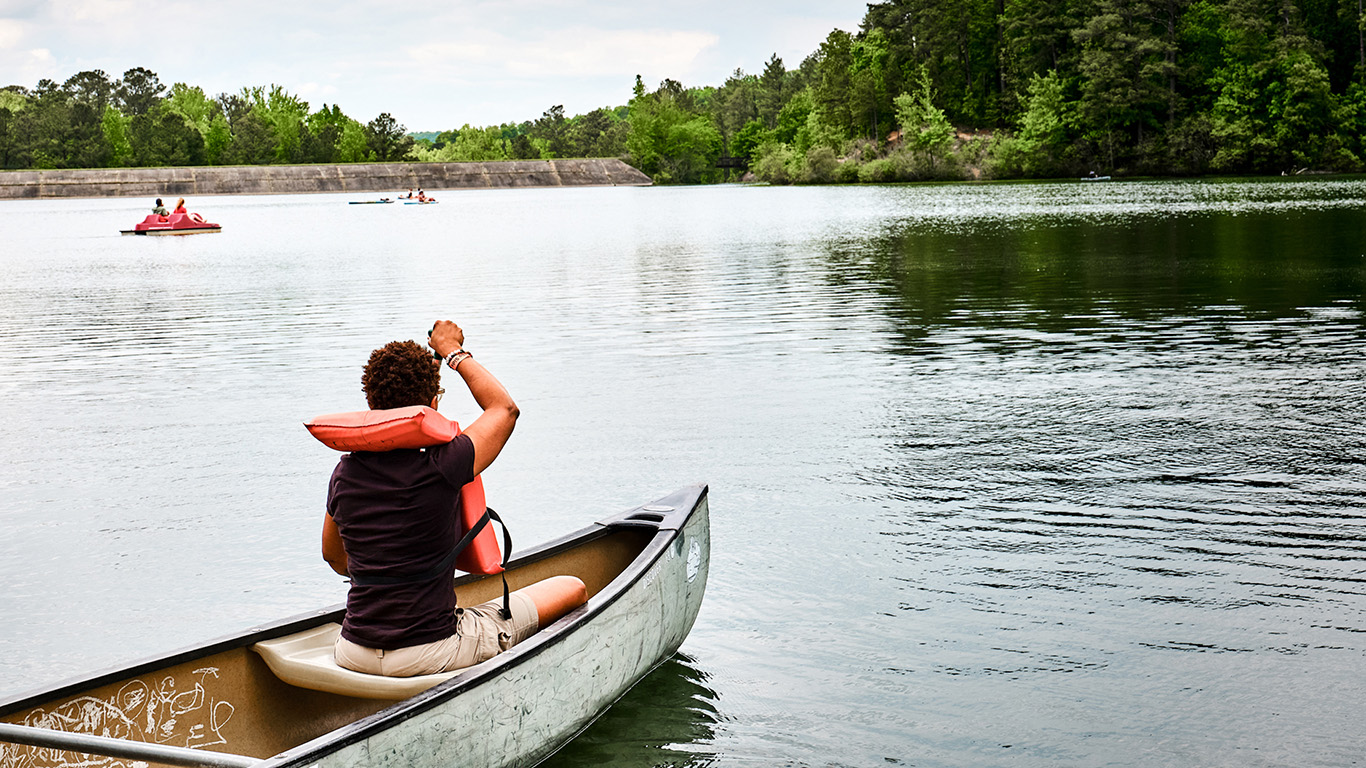
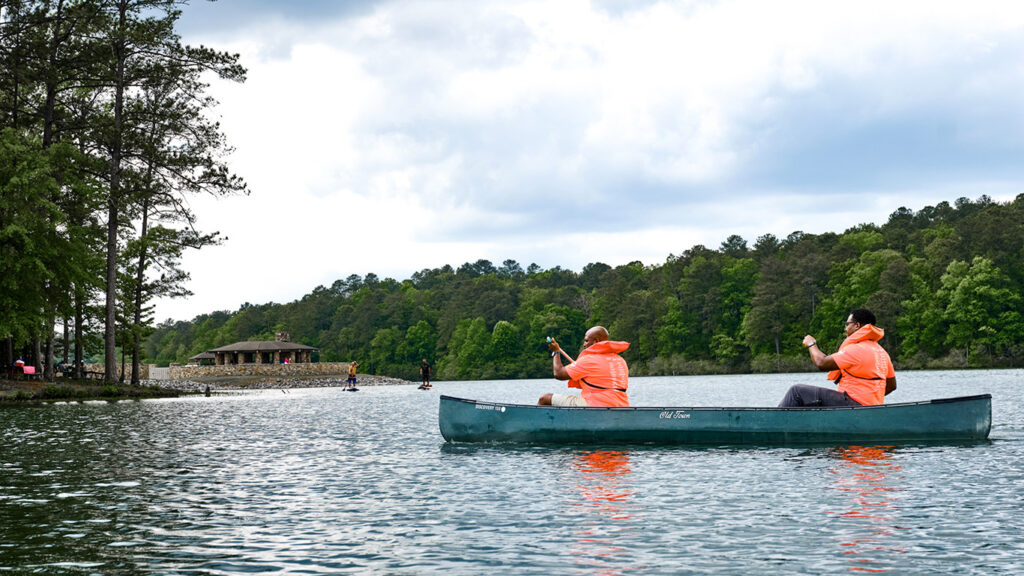
Warm weather means more Sunday fundays on a pontoon boat or pulling out family kayaks and canoes to cruise local rivers. However you prefer to spendtime on the water during summer 2022, safety first. Always! In preparation for the National Safe Boating Council’s National Safe Boating Week (May 21 through May 27), Outdoor Afro wants to remind you of the dos and don’ts to boating season adventures.
“The best boating experience is safe boating,” said Yvonne Pentz, communications director of the National Safe Boating Council, a nonprofit dedicated to helping create a safe boating experience for all boaters and the lead organization of the Safe Boating Campaign. “Have fun on the water, make memories with your family and friends – all while boating responsibly.” That said, here are five best practices to help you stay safe while creating water moments:
LIFEJACKETS. LIFEJACKETS. LIFEJACKETS. Lifejackets. It doesn’t matter if you’re a beginner or veteran swimmer, wearing a lifejacket (or at the very least, having them nearby) should always be at the top of your safety list. The council recommends having life jackets on children under the age of 13 while swimming or during other activities on open water. This also holds true for adults while boating.
ENGINE CUT-OFF DEVICE. Things happen. Better to be safe than sorry. Emergencies can arise on the water at any time. Whether you drop something into the water, or worse, a person goes overboard. An engine cut-off device — often worn around your wrist or attached to your lifejacket — ensures the boat’s engine will shut off instantly.
DON'T BOOZE AND BOAT. Yes, a BUI is most definitely a thing. So, no “Boating Under The Influence.” According to the council, BUIs accounts for one-third of all recreational boating fatalities. We all want to have fun on the water, but just like with a car, getting behind the wheel while under the influence is a big no-no. Alcohol impacts vision, balance, coordination, and judgment. Increasing the likelihood of accidents. Know that it’s illegal to operate a watercraft under the influence of both drugs and alcohol in every state. The Coast Guard enforces a federal law that provides BUIs, too. Including all boats: canoes, rowboats and ships.
BE AWARE OF CARBON MONOXIDE EXPOSURE. Most people don’t associate boats with producing carbon monoxide, but they certainly do. Because it’s an odorless and colorless gas, you likely won’t know if it’s being emitted. The best thing to do to remain safe on the water is to avoid swimming anywhere near the rear of a motorized vessel, or sitting along the swim deck/platform while the boat motor is running.
HAVE A PLAN, WAYS TO COMMUNICATE BEYOND THE BOAT. Again, you never know what could happen during your outdoor water journeys. It’s always great practice to let someone back ashore know your route plan as well as how long you plan to be on the water. You’ll also want to make sure any communication devices like phones, emergency locator beacons, or walkie-talkies are charged, have a signal, and work properly.
Outdoor Afro Wins the National Wildlife Federation Communication Award
Outdoor Afro Founder Wins Prestigious Award at National Wildlife Federation’s
National Conservation Achievement Awards

Outdoor Afro founder, Rue Mapp of Oakland, California has been selected as the recipient of the National Wildlife Federation’s (NWF) 2014 Communications award. Mapp is receiving this prestigious award for her dedication to environmental education and passion for connecting African-Americans with nature. Mapp will receive the award on Wednesday, April 30, 2014, at NWF’s Conservation Achievement Awards in Washington D.C.

Rue Mapp has worked for more than two decades with digital media to reinvent African-American connections to nature, and in 2009, Outdoor Afro was born. As the founder and CEO of the social media and urban leadership network, Rue Mapp has motivated African-Americans across the nation to spend more time in nature.
“Rue Mapp is an innovative individual who has sought to create a greater connection between African-Americans and the environment through the use of online technologies,” said Larry Schweiger, president and CEO of the National Wildlife Federation. “Through her passion for nature and Outdoor Afro, she has inspired many individuals and communities to appreciate nature and to venture into the great outdoors.”
Rue Mapp supplements this effort in a variety of ways including service on National Wildlife Federation’s California Advisory Council. She was also appointed program officer at the Stewardship Council’s Foundation for Youth Investment where she served for two years managing its grant making program.
Recognition for Rue Mapp’s innovative and effective ideas has been honored by the Obama administration. She was invited to the White House to participate in the kick-off of America’s Great Outdoors initiative and the launch of Michelle Obama’s Let’s Move! campaign. Backpacker Magazine named her a Hero, she was placed on the Root 100 of the top African-American achievers and influencers for 2012, received the Outdoor Industry’s Inspiration Award and named a NewsOne for black America “Game Changer” in 2013. She has also received California’s Josephine and Frank Dunaneck award for her humanitarian efforts. Rue Mapp exemplifies the leadership needed in the world of environmental education to motivate our next generation to get outside and become the conservation leaders of tomorrow.
For more National Wildlife Federation news, please visit: www.nwf.org/news.
The National Wildlife Federation is America's largest conservation organization inspiring Americans to protect wildlife for our children's future.
Introducing the 2012 Outdoor Afro Leadership Team!
From making trips to Washington D.C. to provide input on initiatives ranging from Michelle Obama’s Let’s Move Campaign to providing ideas to the Department of Interior on ways to engage African American families in outdoor recreation, Rue Mapp, Outdoor Afro Founder and CEO, realized, “I can’t do all of this myself,” and sought out more leaders to work along side her to engage more African Americans with the outdoors.
 Over the past four months, she recruited thirteen Outdoor Afro volunteers (“disciples” she likens them to), who share her passion for nature and connecting more people to it. But these folks are not just advocates. They will organize outdoor activities across the country, from day hikes to overnight camping trips.
The Outdoor Afro Leadership Team (OALT) will organize trips on a quarterly basis, but Rue is prepared for the effort to grow beyond that.
Leveraging the Outdoor Afro social media community to recruit volunteers, she said, “I feel blessed to have found a group of like-minded people who can help literally move African Americans into the outdoors in greater numbers than I could alone.” The team represents a wonderfully diverse group from around the country, with a range of interests and expertise.
Introducing the 2012 Outdoor Afro Leadership Team!

- Alisha Pye, a Los Angeles, CA Pilates instructor and mother of two.

- Beky Branagan of North Carolina has an M.S. in Recreation Administration and served as a medic in the US Army Reserve. She volunteers as an Outdoor Skills Facilitator; teaching Girl Scout Leaders about how to take their troops camping.

- Charles Yellowday, a Bronx, NY based social services professional.

- Cliff Sorrell, a SF Bay Area based landscape architect, assistant Scout Master and Cub Scout leader.

- Danielle Lee, a St. Louis, MO scientist and blogger specializing in mammalogy, ecology and animal behavior.

- Karen Bayard, a Salt Lake City, Utah-based college professor and community health educator.

- Karla Frye, a Jefferson City, MO resident who works as manager of urban initiatives for Missouri State Parks. Frye has previously worked as a journalist, a research analyst, and public relations consultant and university professor.

- Melissa Danielle, a New York City resident who promotes healthy lifestyles and wellness through her work as director of Central Brooklyn Wellness.

- Nkrumah Frazier, a Southern Mississippi Biology research technician at the University Of Southern MS and Hattiesburg Green Living Examiner and focused on the latest science and environmental research.

- Reginald Mitchell of Atlanta, GA is an outdoor enthusiast and hike leader for We Love to Hike.

- Sherrita Cole, of Oakland, CA, mom of a toddler, property manager, and hair care blogger

- Viva Yeboah, of Chicago IL, recently embraced outdoor connections through her participation with Girl Trek

- Zoe Polk, a San Francisco, CA resident and human rights attorney.
All regional leaders will be organizing day hikes, casual recreation, camping trips, bicycle rides and other activities on a quarterly basis and in their local regions.
Schedules of upcoming outings will be posted on Outdoor Afro as they become available, and check out the newly-launched Meet-Up groups as well:

SF Bay Area
Atlanta
New York (Brooklyn)
Outdoor Afro thanks REI, the national outdoor retail cooperative, KEEN Shoes, and Camp-California who are sponsoring the OALT with gear and practical support to inform trip ideas and support our success!


